
|
You entered: nearby
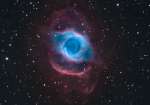 NGC 7293: The Helix Nebula
4.10.2012
A mere seven hundred light years from Earth, in the constellation Aquarius, a sun-like star is dying. Its last few thousand years have produced the Helix Nebula (NGC 7293), a well studied and nearby example of a Planetary Nebula, typical of this final phase of stellar evolution.
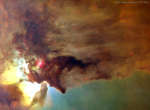 In the Center of the Lagoon Nebula
20.05.2017
The center of the Lagoon Nebula is a whirlwind of spectacular star formation. Visible on the lower left, at least two long funnel-shaped clouds, each roughly half a light-year long, have been formed by extreme stellar winds and intense energetic starlight. The tremendously bright nearby star, Hershel 36, lights the area.
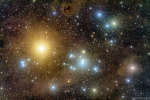 The Hyades Star Cluster
21.01.2020
It is the closest cluster of stars to the Sun. The Hyades open cluster is bright enough to have been remarked on even thousands of years ago, yet is not as bright or compact as the nearby Pleiades (M45) star cluster.
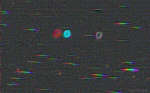 Colors: Ring Nebula versus Stars
20.07.2021
What if you could see, separately, all the colors of the Ring? And of the surrounding stars? There's technology for that. The featured image shows the Ring Nebula (M57) and nearby stars through such technology: in this case, a prism-like diffraction grating.
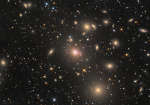 NGC 1275 in the Perseus Cluster
4.02.2026
Active galaxy NGC 1275 is the central, dominant member of the large and relatively nearby Perseus Cluster of Galaxies. Wild-looking at visible wavelengths, the active galaxy is also a prodigious source of x-rays and radio emission.
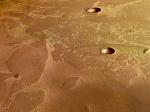 Unusual Plates on Mars
27.02.2005
What are those unusual plates on Mars? A leading current interpretation holds that they are blocks of ice floating on a recently frozen sea covered by dust. The unusual plates were photographed recently by the European Space Agency's Mars Express spacecraft currently orbiting Mars.
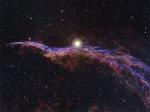 NGC 6960: The Witch's Broom Nebula
31.12.2006
Ten thousand years ago, before the dawn of recorded human history, a new light must suddenly have appeared in the night sky and faded after a few weeks. Today we know this light was an exploding star and record the colorful expanding cloud as the Veil Nebula.
 Sivan 2 to M31
2.03.2017
From within the boundaries of the constellation Cassiopeia (left) to Andromeda (right), this telescopic mosaic spans over 10 degrees in planet Earth's skies. The celestial scene is constructed of panels that are part of a high-resolution astronomical survey of the Milky Way in hydrogen-alpha light.
 A Distant Galaxy in the Deep Field
28.06.1996
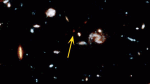
Researchers believe that the faint reddish smudge indicated by the arrow in the image above is a candidate for the most distant known galaxy which may have existed only a few hundred million years after the Big Bang.
 Molecular Cloud Barnard 68
22.03.2008
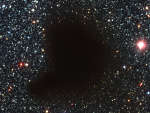
Where did all the stars go? What used to be considered a hole in the sky is now known to astronomers as a dark molecular cloud. Here, a high concentration of dust and molecular gas absorb practically all the visible light emitted from background stars.
|
January February March April May June July August |
||||||||||||||||||||||||||||||||||||||||||||||||||||||||