
|
You entered: light
 APOD: 2025 November 23 Б The Observable Universe
23.11.2025
How far can you see? Everything you can see, and everything you could possibly see, right now, assuming your eyes could detect all types of radiations around you -- is the observable universe. In light...
 Where is HD 189733
21.03.2008
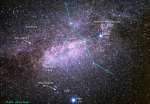
The star cataloged as HD 189733 is a mere 63 light-years away. Its location is indicated in this deep, wide-angle image of the sky centered on the northern constellation of Cygnus. Considering the many...
 Tisdale 2 Rock Formation on Mars
12.09.2011
What does this Martian rock have so much zinc? Roughly the size and shape of a tilted coffee-table, this oddly flat, light-topped rock outcropping was chanced upon a few weeks ago by the robotic Opportunity rover currently rolling across Mars.
 Milky Way vs Airglow Australis
17.05.2018
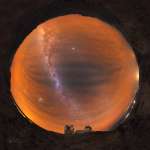
Captured last week after sunset on a Chilean autumn night, an exceptional airglow floods this allsky view from Las Campanas Observatory. The airglow was so intense it diminished parts of the Milky Way as it arced horizon to horizon above the high Atacama desert.
 The Colors of Saturn from Cassini
30.03.2020
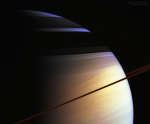
What creates Saturn's colors? The featured picture of Saturn only slightly exaggerates what a human would see if hovering close to the giant ringed world. The image was taken in 2005 by the robot Cassini spacecraft that orbited Saturn from 2004 to 2017.
 The Observable Universe
16.03.2022
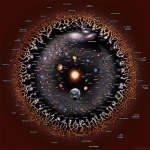
How far can you see? Everything you can see, and everything you could possibly see, right now, assuming your eyes could detect all types of radiations around you -- is the observable universe. In light...
 ULXs in M74
30.03.2005
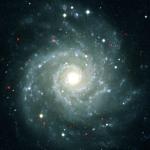
In visual appearance, M74 is a nearly perfect face-on spiral galaxy, about 30 million light-years away toward the constellation Pisces. The red blotches seen in this composite view are ultraluminous x-ray sources (ULXs) mapped by the Chandra X-ray Observatory.
 Reflected Aurora Over Alaska
12.02.2013
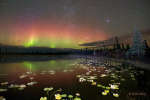
Some auroras can only be seen with a camera. They are called subvisual and are too faint to be seen with the unaided eye. In the above image, the green aurora were easily visible to the eye, but the red aurora only became apparent after a 20-second camera exposure.
 A Blue Bridge of Stars between Cluster Galaxies
15.07.2014
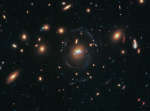
Why is there a blue bridge of stars across the center of this galaxy cluster? First and foremost the cluster, designated SDSS J1531+3414, contains many large yellow elliptical galaxies. The cluster's center...
 Sunspot Group AR 2339 Crosses the Sun
29.06.2015
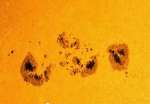
How do sunspots evolve? Large dark sunspots -- and the active regions that contain them -- may last for weeks, but all during that time they are constantly changing. Such variations were particularly apparent...
|
January February March April May June July August September October |
|||||||||||||||||||||||||||||||||||||||||||||||||