
|
You entered: light
 APOD: 2024 July 30 Б Arp 142: Interacting Galaxies from Webb
30.07.2024
To some, it looks like a penguin. But to people who study the universe, it is an interesting example of two big galaxies interacting. Just a few hundred million years ago, the upper NGC 2936 was likely a normal spiral galaxy: spinning, creating stars, and minding its own business.
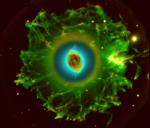 Halo of the Cat's Eye
1.11.2003
The Cat's Eye Nebula (NGC 6543) is one of the best known planetary nebulae in the sky. Its haunting symmetries are seen in the very central region of this stunning false-color picture, processed...
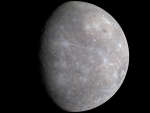 Mercury in Accentuated Color
19.03.2008
The colors of Mercury are subtle but beautiful. At first glance, our Solar System's innermost planet appears simply black and white, but images that include infrared colors normally beyond human vision accentuate a world of detail. One such image, shown above, was acquired by the robotic MESSENGER spacecraft that swung by Mercury in mid-January.
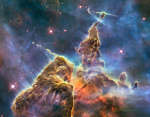 Dust Pillar of the Carina Nebula
26.04.2010
Inside the head of this interstellar monster is a star that is slowly destroying it. The monster, on the right, is actually an inanimate pillar of gas and dust that measures over a light year in length.
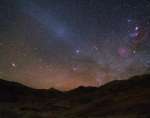 The Gegenschein Over Chile
14.01.2014
Is the night sky darkest in the direction opposite the Sun? No. In fact, a rarely discernable faint glow known as the gegenschein (German for "counter glow") can be seen 180 degrees around from the Sun in an extremely dark sky. The gegenschein is sunlight back-scattered off small interplanetary dust particles.
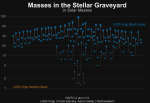 Fifty Gravitational Wave Events Illustrated
4.11.2020
Over fifty gravitational wave events have now been detected. These events mark the distant, violent collisions of two black holes, a black hole and a neutron star, or two neutron stars. Most of the 50 events were detected in 2019 by the LIGO gravitational wave detectors in the USA and the VIRGO detector in Europe.
 Comet Olbers over Kunetice Castle
1.08.2024
A visitor to the inner solar system every 70 years or so Comet 13P/Olbers reached its most recent perihelion, or closest approach to the Sun, on June 30 2024. Now on a return voyage...
 APOD: 2025 September 11 Б The Umbra of Earth
11.09.2025
The dark, inner shadow of planet Earth is called the umbra. Shaped like a cone extending into space, it has a circular cross section most easily seen during a lunar eclipse.
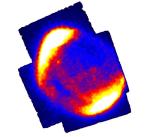 SN 1006: Pieces of the Cosmic Ray Puzzle
2.12.2000
Research balloon flights conducted in 1912 by Austrian physicist Victor Hess revealed that the Earth was constantly bombarded by high energy radiation from space - which came to be called "Cosmic Rays". What are Cosmic Rays and where do they come from?
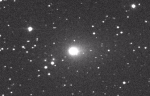 Hyakutake: The Great Comet of 1996?
8.02.1996
Get ready for one of the most impressive but least anticipated light shows in modern astronomical history. Next month, newly discovered Comet Hyakutake will pass closer to the Earth than any recent comet. Unknown...
|
January February March April May June July August September October |
|||||||||||||||||||||||||||||||||||||||||||||||||