
|
You entered: hydrogen
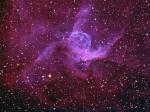 Thor s Helmet in H Alpha
2.02.2006
Near picture center, the helmet-shaped structure with wing-like appendages is popularly called Thor's Helmet. Cataloged as NGC 2359, the striking nebula is located about 15,000 light-years away in the constellation Canis Major.
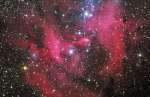 IC 2948: The Running Chicken Nebula
18.04.2008
Bright nebulae abound in and around the expansive southern constellation of Centaurus. This one, cataloged as IC 2948 is near the star Lambda Centauri and not far on the sky from the better known Eta Carinae Nebula.
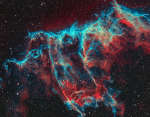 A Spectre in the Eastern Veil
1.11.2008
Menacing flying forms and garish colors are a mark of the Halloween season. They also stand out in this cosmic close-up of the eastern Veil Nebula. The Veil Nebula itself is a large supernova remnant, the expanding debris cloud from the death explosion of a massive star.
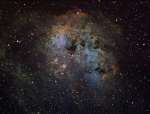 IC 410 and NGC 1893
17.01.2009
Dusty emission nebula IC 410 lies about 12,000 light-years away in the northern constellation Auriga. The cloud of glowing gas is over 100 light-years across, sculpted by stellar winds and radiation from embedded open star cluster NGC 1893.
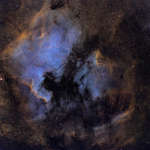 North America and the Pelican
18.12.2010
Here lie familiar shapes in unfamiliar locations. On the left is an emission nebula cataloged as NGC 7000, famous partly because it resembles our fair planet's continent of North America. The emission region to the right of the North America Nebula is IC 5070, also known for its suggestive outlines as the Pelican Nebula.
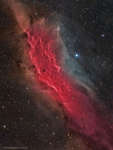 The California Nebula
12.01.2016
What's California doing in space? Drifting through the Orion Arm of the spiral Milky Way Galaxy, this cosmic cloud by chance echoes the outline of California on the west coast of the United States.
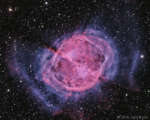 M27: The Dumbbell Nebula
2.11.2016
The first hint of what will become of our Sun was discovered inadvertently in 1764. At that time, Charles Messier was compiling a list of diffuse objects not to be confused with comets.
 NGC 6995: The Bat Nebula
27.10.2021
Do you see the bat? It haunts this cosmic close-up of the eastern Veil Nebula. The Veil Nebula itself is a large supernova remnant, the expanding debris cloud from the death explosion of a massive star.
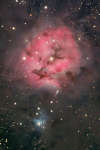 IC 5146: The Cocoon Nebula
27.08.2022
Inside the Cocoon Nebula is a newly developing cluster of stars. Cataloged as IC 5146, the beautiful nebula is nearly 15 light-years wide. Climbing high in northern summer night skies, it's located some 4,000 light years away toward the constellation Cygnus the Swan.
 APOD: 2025 July 30 Б Coronal Loops on the Sun
30.07.2025
Our Sun frequently erupts in loops. Hot solar plasma jumps off the Sun's surface into prominences, with the most common type of prominence being a simple loop. The loop shape originates from the Sun's magnetic field, which is traced by spiraling electrons and protons.
|
January February March April May June July August September October |
|||||||||||||||||||||||||||||||||||||||||||||||||