
|
You entered: hydrogen
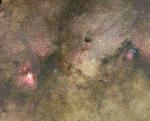 APOD: 2002 September 18- A Sagittarius Starscape
18.09.2002
Many vast star fields in the plane of our Milky Way Galaxy are rich in clouds of stars, dust, and gas. First and foremost, visible in the above picture are millions of stars, many of which are similar to our Sun.
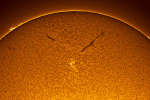 A Sunspot in the New Solar Cycle
6.02.2008
A new cycle has begun on our Sun. Over the past year, the Sun's magnetic field has reset and now a new 11 year period is beginning. Pictured above in a specific color of light emitted by hydrogen is sunspot 10982, one of the first sunspots of the new solar cycle.
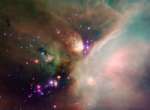 Young Stars in the Rho Ophiuchi Cloud
15.02.2008
Cosmic dust clouds and embedded newborn stars glow at infrared wavelengths in this tantalizing false-color view from the Spitzer Space Telescope. Pictured is of one of the closest star forming regions, part of the Rho Ophiuchi cloud complex some 400 light-years distant near the southern edge of the pronounceable constellation Ophiuchus.
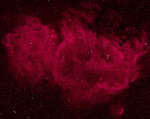 IC 1848: The Soul Nebula
15.04.2013
Stars are forming in the Soul of the Queen of Aethopia. More specifically, a large star forming region called the Soul Nebula can be found in the direction of the constellation Cassiopeia, who Greek mythology credits as the vain wife of a King who long ago ruled lands surrounding the upper Nile river.
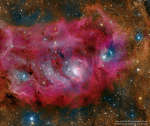 The Lagoon Nebula in High Definition
14.12.2016
Stars are battling gas and dust in the Lagoon Nebula but the photographers are winning. Also known as M8, this photogenic nebula is visible even without binoculars towards the constellation of Sagittarius. The energetic processes of star formation create not only the colors but the chaos.
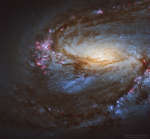 Spiral Galaxy M66 from Hubble
24.02.2021
ItБs always nice to get a new view of an old friend. This stunning Hubble Space Telescope image of nearby spiral galaxy M66 is just that. A spiral galaxy with a small central bar, M66 is a member of the Leo Galaxy Triplet, a group of three galaxies about 30 million light years from us.
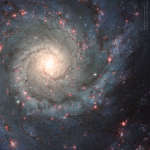 A Perfect Spiral
13.08.2021
If not perfect then this spiral galaxy is at least one of the most photogenic. An island universe of about 100 billion stars, 32 million light-years away toward the constellation Pisces, M74 presents a gorgeous face-on view.
 APOD: 2025 August 4 Б Blue Arcs Toward Andromeda
4.08.2025
What are these gigantic blue arcs near the Andromeda Galaxy (M31)? Discovered in 2022 by amateur astronomers, the faint arcs -- dubbed SDSO 1 -- span nearly the same angular size as M31 itself. At first, their origin was a mystery: are they actually near the Andromeda Galaxy, or alternatively near to our Sun?
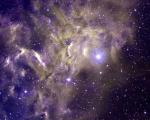 AE Aurigae: The Flaming Star
4.12.2001
Is star AE Aurigae on fire? Although surrounded by what may look like smoke, the object known as the "flaming star" creates energy primarily by nuclear fusion, like other stars. Fire, typically defined...
 The Great Nebula in Orion
3.07.1995
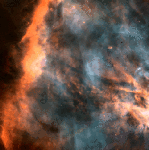
The Great Nebula in Orion, M42, can be found on the night sky just below and to the left of the easily identifiable belt of three stars in the popular constellation Orion. This nebula is one of the closest stellar nurseries - where young stars are being formed even now.
|
January February March April May June July August September October |
|||||||||||||||||||||||||||||||||||||||||||||||||