
|
You entered: Jupiter
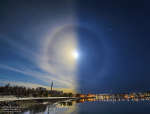 Sun and Moon Halo
3.04.2015
Two pictures captured on April 1 are combined in this creative day and night composite. Separated in time by about 10 hours the images otherwise match, looking along the coast at Östersund Sweden.
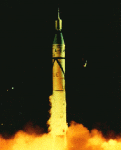 The First Explorer
6.02.1999
The first US spacecraft was Explorer 1. The cylindrical 30 pound satellite was launched (above) as the fourth stage of a Jupiter-C rocket (a modified US Army Redstone ballistic missile) and achieved orbit on January 31, 1958.
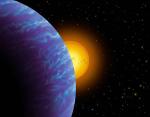 The Decade that Defined Star System
29.12.1999
As the 1990s began, the only planetary star system known was our own Solar System. The first extra-solar star system was discovered orbiting a pulsar in 1991. Slight changes in the precise arrival times of the pulses from the central small dense neutron star gave evidence of orbiting planets.
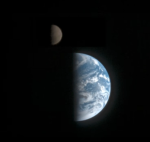 Earth and Moon
5.09.2021
The Earth and Moon are rarely photographed together. One of most spectacular times this occurred was about 30 years ago when the Jupiter-bound Galileo spacecraft zoomed past our home planetary system. Then, robotic Galileo watched from about 15-times the Earth-Moon separation as our only natural satellite glided past our home world.
 Alborz Mountain Milky Way
3.05.2008
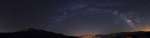
Snow-capped stratovolcano Mt. Damavand climbs to 5,670 meters (18,598 feet) near the left edge in this panoramic view of the world at night. Pan to the right and your gaze will sweep across the arch of our Milky Way Galaxy above the Alborz Mountain Range bordering the Caspian Sea.
 Dawn of the Dish
19.07.2012
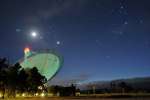
Wandering planets Venus and Jupiter were joined by an old crescent Moon near the eastern horizon on July 15. This serene southern skyview of the much anticipated predawn conjunction includes the lovely Pleiades star cluster and bright stars Aldebaran and Betelgeuse in the celestial lineup.
 Night Sky Reflected
13.09.2021
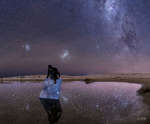
What's that in the mirror? In the featured image of the dark southern sky, the three brightest galaxies of the night are all relatively easy to identify. Starting from the left, these are the Small Magellanic Cloud (SMC), the Large Magellanic Cloud (LMC), and part of the central band of our Milky Way Galaxy.
 Mars Approach
1.06.2018
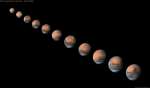
Since the distance from Earth to Mars changes drastically as the planets orbit the Sun, Mars' appearance changes dramaticaly. Mars is bright now, and it's getting closer and brighter still as it orbits toward its 2018 opposition and closest approach to Earth in late July.
 Moon, Four Planets, and Emu
8.02.2019
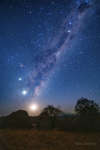
A luminous Milky Way falls toward the horizon in this deep skyscape, starting at the top of the frame from the stars of the Southern Cross and the dark Coalsack Nebula. Captured...
 Light and Glory over Crete
16.11.2020
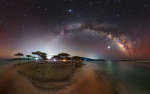
The month was July, the place was the Greek island of Crete, and the sky was spectacular. Of course there were the usual stars like Polaris, Vega, and Antares -- and that common asterism everyone knows: the Big Dipper. But this sky was just getting started.
|
January February March April May June July August September October |
|||||||||||||||||||||||||||||||||||||||||||||||||