
|
You entered: Jupiter
 Epsilon Tauri: Star with Planet
26.01.2024
Epsilon Tauri lies 146 light-years away. A K-type red giant star, epsilon Tau is cooler than the Sun, but with about 13 times the solar radius it has nearly 100 times the solar luminosity.
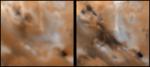 Io: The Fissure King?
29.11.1996
Is Io the solar system's Fissure King? Well, probably not ... but it is the most active volcanic moon. Active volcanoes on Jupiter's moon Io were a surprise discovery of the Voyager missions of the late 1970s.
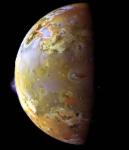 Io: The Prometheus Plume
18.08.1997
Two sulfurous eruptions are visible on Jupiter's volcanic moon Io in this color composite Galileo image. On the left, over Io's limb, a new bluish plume rises about 86 miles above the surface of a volcanic caldera known as Pillan Patera.
 A Planet For Gliese 876
26.06.1998
Centered in this unremarkable, 1/4 degree wide patch of sky in the constellation Aquarius is the star Gliese 876. Gliese 876 is smaller than the Sun, only about 1/3 as massive, and too faint to be seen without a telescope. But it is known to be one of the nearest stars, only 15 light-years distant.
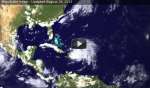 Hurricane Irene Forms
27.08.2011
How does a hurricane form? Although a complete picture is still being researched, insight into this process might be gleaned by watching the above time lapse movie of the formation of Hurricane Irene, a large storm system currently threatening the eastern seaboard of the USA.
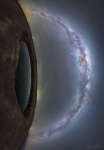 Eye on the Milky Way
21.04.2020
Have you ever had stars in your eyes? It appears that the eye on the left does, and moreover it appears to be gazing at even more stars. The featured 27-frame mosaic was taken last July from Ojas de Salar in the Atacama Desert of Chile.
 A December Winter Night
28.12.2024
Orion seems to come up sideways, climbing over a distant mountain range in this deep skyscape. The wintry scene was captured from southern Poland on the northern hemisphere's long solstice night. Otherwise unseen nebulae hang in the sky, revealed by the camera modified to record red hydrogen-alpha light.
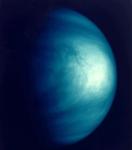 Venus: Just Passing By
1.05.1998
Venus, the second closest planet to the Sun, is a popular way-point for spacecraft headed for the gas giant planets in the outer reaches of the solar system. Why visit Venus first? Using...
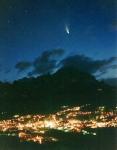 A Comet In The Sky
28.03.1997
It has been suggested that Comet Hale-Bopp will become the most viewed comet in Human history. Presently, for denizens of the Earth's northern hemisphere, this bright comet is certainly a lovely and inspiring sight -- visible here crowning the sky above Cortina d'Ampezzo, Italy on March 20.
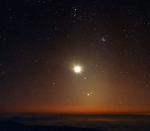 Planets Above The Clouds
4.05.2000
Clouds scatter the faint orange rays of the setting sun in the foreground of this breathtaking photograph from the summit of Mauna Kea, Hawaii. Taken on April 7th, this skyscape features a dramatic lunar and planetary alignment.
|
January February March April May June July August September October |
|||||||||||||||||||||||||||||||||||||||||||||||||