
|
You entered: apod
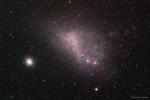 APOD: 2007 October 1- The Small Cloud of Magellan
1.10.2007
Portuguese navigator Ferdinand Magellan and his crew had plenty of time to study the southern sky during the first circumnavigation of planet Earth. As a result, two celestial wonders easily visible for southern hemisphere skygazers are known as the Clouds of Magellan.
 APOD: 2023 April 16 Б M2 9: Wings of a Butterfly Nebula
16.04.2023
Are stars better appreciated for their art after they die? Actually, stars usually create their most artistic displays as they die. In the case of low-mass stars like our Sun and M2-9 pictured here, the stars transform themselves from normal stars to white dwarfs by casting off their outer gaseous envelopes.
 APOD: 2023 July 4 Б Aurora over Icelandic Waterfall
4.07.2023
It seemed like the sky exploded. The original idea was to photograph an aurora over a waterfall. After waiting for hours under opaque clouds, though, hope was running out. Others left. Then, unexpectedly, the clouds moved away.
 APOD: 2025 August 10 Б Zodiacal Road
10.08.2025
What's that strange light down the road? Dust orbiting the Sun. At certain times of the year, a band of sun-reflecting dust from the inner Solar System appears prominently just after sunset -- or just before sunrise -- and is called zodiacal light.
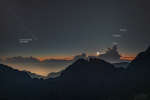 APOD: 2026 April 18 Б PanSTARRS and Planets
18.04.2026
Near the eastern horizon before sunrise, Comet C/2025 R3 PanSTARRS is getting brighter. Readily visible in binoculars and small telescopes, the comet may be just on the verge of naked-eye visibility from dark sky sites.
 APOD: 2025 January 13 Б Comet ATLAS Before Sunrise
13.01.2025
Comet ATLAS is really bright now, but also really close to the Sun. Outside the glow of the Sun, Comet C/2024 G3 (ATLAS) would be one of the more remarkable comet sights of recent years, reflecting about as much sunlight to Earth as Comet Tsuchinshan-ATLAS did in October, and now rivaling even planet Venus.
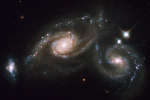 APOD: 2009 April 7 The Colliding Spiral Galaxies of Arp 274
7.04.2009
Two galaxies are squaring off in Virgo and here are the latest pictures. When two galaxies collide, the stars that compose them usually do not. This is because galaxies are mostly empty space and, however bright, stars only take up only a small fraction of that space.
 APOD: 2023 June 25 Б Lightning on Jupiter
25.06.2023
Does lightning occur only on Earth? No. Spacecraft in our Solar System have detected lightning on other planets, including Mars, Jupiter and Saturn, and lightning is likely on Venus, Uranus, and Neptune. Lightning is a sudden rush of electrically charged particles from one location to another.
 APOD: 2024 October 6 Б The Magnificent Tail of Comet McNaught
6.10.2024
Comet McNaught, the Great Comet of 2007, grew a spectacularly long and filamentary tail. The magnificent tail spread across the sky and was visible for several days to Southern Hemisphere observers just after sunset. The amazing ion tail showed its greatest extent on long-duration, wide-angle camera exposures.
 APOD: 2025 January 8 Б Supernova Remnants Big and Small
8.01.2025
What happens after a star explodes? A huge fireball of hot gas shoots out in all directions. When this gas slams into the existing interstellar medium, it heats up so much it glows. Two different supernova remnants (SNRs) are visible in the featured image, taken at the Oukaцmeden Observatory in Morocco.
|
January February March April May June July August |
||||||||||||||||||||||||||||||||||||||||||||||||||||||||