
|
You entered: apod
 APOD: 2024 October 28 Б STEVE: A Glowing River over France
28.10.2024
Sometimes a river of hot gas flows over your head. In this case the river created a Strong Thermal Emission Velocity Enhancement (STEVE) that glowed bright red, white, and pink. Details of how STEVEs...
 APOD: 2025 July 2 Б Milky Way Through Otago Spires
2.07.2025
Does the Milky Way always rise between these two rocks? No. Capturing this stunning alignment took careful planning: being in the right place at the right time. In the featured image taken in June...
 APOD: 2025 September 18 Б Comet C/2025 R2 SWAN
18.09.2025
A new visitor from the outer Solar System, comet C/2025 R2 (SWAN) also known as SWAN25B was only discovered late last week, on September 11. That's just day before the comet reached perihelion, its closest approach to the Sun.
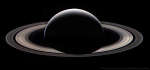 APOD: 2026 June 1 Б Saturn at Night
1.06.2026
Telescopic views of Saturn and its beautiful rings often make it the star of star parties. But this stunning view of the outer gas gaint planet's rings and night side just isn't possible from telescopes in the vicinity of planet Earth.
 APOD: 2024 April 17 Б Total Eclipse and Comets
17.04.2024
Not one, but two comets appeared near the Sun during last week's total solar eclipse. The expected comet was Comet 12P/Pons-Brooks, but it was disappointingly dimmer than many had hoped. However, relatively unknown Comet SOHO-5008 also appeared in long duration camera exposures.
 APOD: 2025 March 10 Б NGC 1499: The California Nebula
10.03.2025
Could Queen Calafia's mythical island exist in space? Perhaps not, but by chance the outline of this molecular space cloud echoes the outline of the state of California, USA. Our Sun has its home within the Milky Way's Orion Arm, only about 1,000 light-years from the California Nebula.
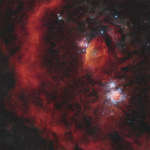 APOD: 2026 February 18 Б Orions Cradle
18.02.2026
Cradled in red-glowing hydrogen gas, stars are being born in Orion. These stellar nurseries lie at the edge of the giant Orion molecular cloud complex, some 1,500 light-years away. This detailed view spans...
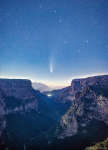 APOD: 2020 August 3 Б Comet NEOWISE over Vikos Gorge
3.08.2020
Did the Earth part to show us this comet? Of course not, even if this image makes it seem that way. Pictured far in the background is Comet NEOWISE as it appeared about two weeks ago over northern Greece.
 APOD: 2023 May 2 Б Flat Rock Hills on Mars
2.05.2023
Why are there so many flat rocks on Mars? Some views of plains and hills on Mars show many rocks that are unusually flat when compared to rocks on Earth. One reason for this is a process that is common to both Mars and Earth: erosion.
 APOD: 2025 August 2 Б Fireflies, Meteors, and Milky Way
2.08.2025
Taken on July 29 and July 30, a registered and stacked series of exposures creates this dreamlike view of a northern summer night. Multiple firefly flashes streak across the foreground as the luminous Milky...
|
January February March April May June July August |
||||||||||||||||||||||||||||||||||||||||||||||||||||||||