
|
You entered: apod
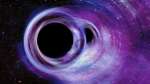 APOD: 2026 April Б Caught in the Web
3.04.2026
How can we see what is invisible? Black holes are not easy to see in the dark cosmic night, but astronomers can find them by analyzing their gravitational effects on matter, light and spacetime.
 APOD: 2023 September 24 Б A Ring of Fire Sunrise Solar Eclipse
24.09.2023
What's rising above the horizon behind those clouds? It's the Sun. Most sunrises don't look like this, though, because most sunrises don't include the Moon. In the early morning of 2013 May 10, however, from Western Australia, the Moon was between the Earth and the rising Sun.
 APOD: 2023 December 27 Б Rainbow Aurora over Icelandic Waterfall
27.12.2023
Yes, but can your aurora do this? First, yes, auroras can look like rainbows even though they are completely different phenomena. Auroras are caused by Sun-created particles being channeled into Earth's atmosphere by Earth's magnetic field, and create colors by exciting atoms at different heights.
 APOD: 2024 December 24 Б Fox Fur, Cone, and Christmas Tree
24.12.2024
What do the following things have in common: a cone, the fur of a fox, and a Christmas tree? Answer: they all occur in the constellation of the Unicorn (Monoceros). Considered as a star...
 APOD: 2024 March 10 Б A Total Eclipse at the End of the World
10.03.2024
Would you go to the end of the world to see a total eclipse of the Sun? If you did, would you be surprised to find someone else there already? In 2003, the Sun, the Moon, Antarctica, and two photographers all lined up in Antarctica during an unusual total solar eclipse.
 APOD: 2024 October 16 Б Colorful Aurora over New Zealand
16.10.2024
Sometimes the night sky is full of surprises. Take the sky over Lindis Pass, South Island, New Zealand one-night last week. Instead of a typically calm night sky filled with constant stars, a busy and dynamic night sky appeared.
 APOD: 2025 January 28 Б Comet G3 ATLAS over Uruguay
28.01.2025
Comets can be huge. When far from the Sun, a comet's size usually refers to its hard nucleus of ice and rock, which typically spans a few kilometers -- smaller than even a small moon.
 APOD: 2025 March 17 Б Thors Helmet
17.03.2025
Thor not only has his own day (Thursday), but a helmet in the heavens. Popularly called Thor's Helmet, NGC 2359 is a hat-shaped cosmic cloud with wing-like appendages. Heroically sized even for a Norse god, Thor's Helmet is about 30 light-years across.
 APOD: 2025 July 26 Б Globular Cluster Omega Centauri
26.07.2025
Globular star cluster Omega Centauri packs about 10 million stars much older than the Sun into a volume some 150 light-years in diameter. Also known as NGC 5139, at a distance...
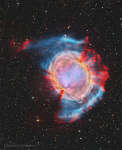 APOD: 2026 June 22 Б M27: The Dumbbell Nebula
22.06.2026
Is this what will become of our Sun? Quite possibly. The first hint of our Sun's future was discovered inadvertently in 1764. At that time, Charles Messier was compiling a list of diffuse objects not to be confused with comets.
|
January February March April May June July August |
||||||||||||||||||||||||||||||||||||||||||||||||||||||||