
|
You entered: telescope
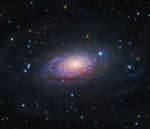 Messier 63: The Sunflower Galaxy
12.07.2017
A bright spiral galaxy of the northern sky, Messier 63 is about 25 million light-years distant in the loyal constellation Canes Venatici. Also cataloged as NGC 5055, the majestic island universe is nearly 100,000 light-years across. That's about the size of our own Milky Way Galaxy.
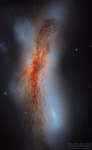 NGC 520: Colliding Galaxies from Hubble
7.09.2021
Is this one galaxy or two? The jumble of stars, gas, and dust that is NGC 520 is now thought to incorporate the remains of two separate disk galaxies. A defining component...
 Trapezium: At the Heart of Orion
5.01.2024
Near the center of this sharp cosmic portrait, at the heart of the Orion Nebula, are four hot, massive stars known as the Trapezium. Gathered within a region about 1.5 light-years in radius, they dominate the core of the dense Orion Nebula Star Cluster.
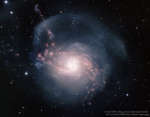 APOD: 2026 April 5 Б NGC 3310: A Starburst Spiral Galaxy
5.04.2026
The party is still going on in spiral galaxy NGC 3310. Roughly 100 million years ago, NGC 3310 likely collided with a smaller galaxy causing the large spiral galaxy to light up with a tremendous burst of star formation.
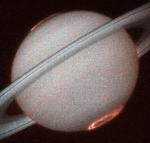 Saturnian Aurora
9.01.1998
Girdling the second largest planet in the Solar System, Saturn's Rings are one of the most spectacular sights for earthbound telescopes. This recently released image, from the orbiting Hubble Space Telescope's STIS instrument, offers a striking view of another kind of ring around Saturn - pole encircling rings of ultraviolet aurora.
 Gordel van Venus
15.06.2006
Scroll right and enjoy this 180 degree panorama across the South African Astronomical Observatory's hilltop Sutherland observing station. Featured are SAAO telescope domes and buildings, along with the dark, wedge-shaped shadow of planet Earth stretching into the distance, bounded above by the delicately colored antitwilight arch.
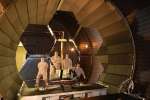 JWST: Mirrors and Masked Men
12.03.2010
Who are these masked men? Technicians from Ball Aerospace and NASA at Marshall Space Flight Center's X-ray and Cryogenic Facility, of course, testing primary mirror segments of the James Webb Space Telescope (JWST).
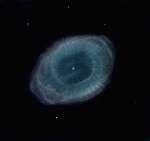 Ring Nebula Drawn
15.09.2012
A planetary nebula with a simple symmetry familiar to telescopic sky gazers, the Ring Nebula (M57) is some 2,000 light-years away in the musical constellation Lyra. Hints of changing colors and subtle details are brought out in this remarkable sketch of the cosmic ring.
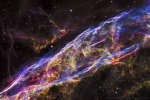 Veil Nebula: Wisps of an Exploded Star
19.09.2017
Wisps like this are all that remain visible of a Milky Way star. About 7,000 years ago that star exploded in a supernova leaving the Veil Nebula. At the time, the expanding cloud was likely as bright as a crescent Moon, remaining visible for weeks to people living at the dawn of recorded history.
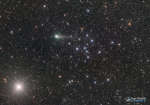 Comet C 2017 K2 (PanSTARRS)
30.06.2022
Imaged on June 20 2022, comet C/2017 K2 (PanSTARRS) shares this wide telescopic field of view with open star cluster IC 4665 and bright star Beta Ophiuchi, near a starry edge of the Milky Way.
|
January February March April May June July August September October |
|||||||||||||||||||||||||||||||||||||||||||||||||