
|
You entered: telescope
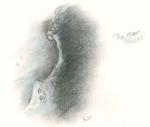 The Moon Maiden
19.06.2003
Along the northwestern reaches of the lunar near side, the Sinus Iridium or Bay of Rainbows appropriately lies at the edge of the Moon's smooth, dark Sea of Rains (Mare Imbrium). In this...
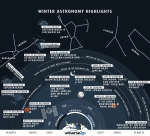 Highlights of the North Winter Sky
5.12.2018
What can you see in the night sky this season? The featured graphic gives a few highlights for Earth's northern hemisphere. Viewed as a clock face centered at the bottom, early (northern) winter sky events fan out toward the left, while late winter events are projected toward the right.
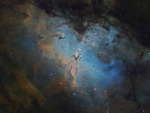 M16 Close Up
10.08.2019
A star cluster around 2 million years young surrounded by natal clouds of dust and glowing gas, M16 is also known as The Eagle Nebula. This beautifully detailed image of the region adopts the colorful Hubble palette and includes cosmic sculptures made famous in Hubble Space Telescope close-ups of the starforming complex.
 A Message From Earth
23.01.2000
What are these Earthlings trying to tell us? The above message was broadcast from Earth towards the globular star cluster M13 in 1974. During the dedication of the Arecibo Observatory - still the largest radio telescope in the world - a string of 1's and 0's representing the
 GL 105C: The Coolest Star?
20.09.1995
Is the dim star to the upper right of this false-color picture the coolest possible normal star? From this recent picture by the Hubble Space Telescope, astronomers have estimated its mass is just high enough for it to fuse hydrogen into helium in its core.
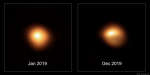 The Changing Surface of Fading Betelgeuse
17.02.2020
Besides fading, is Betelgeuse changing its appearance? Yes. The famous red supergiant star in the familiar constellation of Orion is so large that telescopes on Earth can actually resolve its surface -- although just barely.
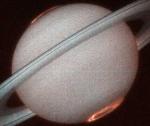 Saturnian Aurora
17.09.2000
Girdling the second largest planet in the Solar System, Saturn's Rings are one of the most spectacular sights for earthbound telescopes. This image from the orbiting Hubble Space Telescope's STIS instrument, offers a striking view of another kind of ring around Saturn - pole encircling rings of ultraviolet aurora.
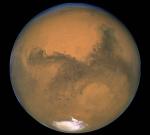 Big Mars from Hubble
27.08.2003
At about 10 am Universal Time today, Mars and Earth will pass closer than in nearly 60,000 years. Mars, noticeably red, will be the brightest object in the eastern sky just after sunset.
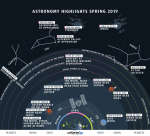 Highlights of the North Spring Sky
13.03.2019
What can you see in the night sky this season? The featured graphic gives a few highlights for Earth's northern hemisphere. Viewed as a clock face centered at the bottom, early (northern) spring sky events fan out toward the left, while late spring events are projected toward the right.
 Vintage Gamma Rays
6.04.2002
Gamma-rays are the most energetic form of electromagnetic radiation. But these high energy photons penetrate and interact in normal materials and cannot be focused by lenses and mirrors like those in optical telescopes. So how do you make an image in gamma-ray light?
|
January February March April May June July August September October |
|||||||||||||||||||||||||||||||||||||||||||||||||