
|
You entered: time
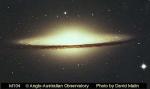 M104: The Sombrero Galaxy
15.08.1999
What's going on in the center of this spiral galaxy? Named the Sombrero Galaxy for its hat-like resemblance, M104 features a prominent dust lane and a bright halo of stars and globular clusters.
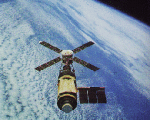 Skylab Over Earth
30.08.1995
Skylab was an orbiting laboratory launched by a Saturn V rocket in May 1973. Skylab was visited three times by NASA astronauts who sometimes stayed as long as two and a half months. Many scientific tests were preformed on Skylab, including astronomical observations in ultraviolet and X-ray light.
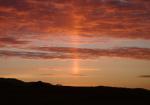 A Sun Pillar
29.12.2002
Have you ever seen a sun pillar? When the air is cold and the Sun is rising or setting, falling ice crystals can reflect sunlight and create an unusual column of light. Ice sometimes forms flat, stop-sign shaped crystals as it falls from high-level clouds.
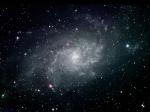 Nearby Spiral M33
13.12.2004
Spiral galaxy M33 is a mid-sized member of our Local Group of Galaxies. M33 is also called the Triangulum Galaxy for the constellation in which it resides. About four times smaller (in radius) than...
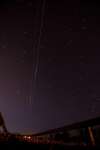 Dawn s Endeavour
26.02.2010
On February 21st, the Space Shuttle Endeavour and the International Space Station (ISS) flew through the sky near dawn over Whitby, Ontario, Canada. Along with star trails, both were captured in this single time exposure. Glinting in sunlight 350 kilometers above the Earth, Endeavour slightly preceeded the ISS arcing over the horizon.
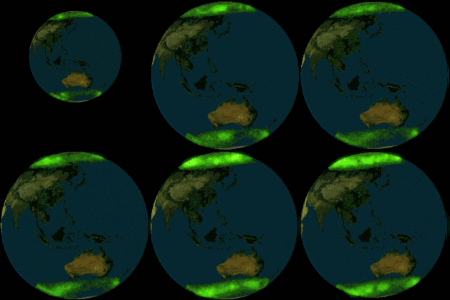 Auroras Over Both Earth Poles
13.11.2001
Auroras in the north and south can be nearly mirror images of each other. Such mirroring had been suspected for centuries but dramatically confirmed only last month by detailed images from NASA's orbiting Polar spacecraft.
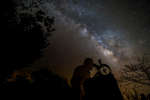 Along the Milky Way
2.07.2021
You can't walk along the Milky Way. Still, under a dark sky you can explore it. To the eye the pale luminous trail of light arcing through the sky on a dark, moonless night does appear to be a path through the heavens.
 The Comet and the Galaxy
24.11.1997
The Moon almost ruined this photograph. During late March and early April, Comet Hale-Bopp passed nearly in front of the Andromeda Galaxy. Here the Great Comet of 1997 and the Great Galaxy in Andromeda were photographed together on March 24th. The problem was the brightness of the Moon.
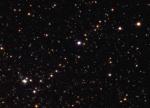 Kembles Cascade
14.08.2000
A picturesque chain of unrelated stars is visible with strong binoculars towards the constellation of Camelopardalis. Known as Kemble's Cascade, the asterism contains about 20 stars nearly in a row stretching over five times the width of a full moon.
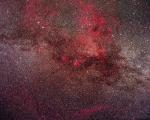 The Gum Nebula Supernova Remnant
20.04.2003
Because the Gum Nebula is the closest supernova remnant, it is actually hard to see. Spanning 40 degrees across the sky, the nebula is so large and faint it is easily lost in the din of a bright and complex background.
|
January February March April May June July August |
||||||||||||||||||||||||||||||||||||||||||||||||||||||||