
|
You entered: time
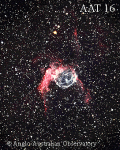 A Wolf Rayet Star Bubble
28.09.1997
What's a Wolf-Rayet star, and how did it create that spherical bubble and sweeping arc? A Wolf-Rayet star is a star that originated with a mass over 40 times that of our Sun.
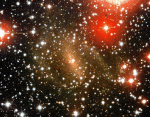 Galaxy Dwingeloo 1 Emerges
17.10.1995
If you look closely at the center of the above photograph, you will see a spiral galaxy behind the field of stars. Named Dwingeloo 1, this nearby galaxy was only discovered recently (1994) because much of its light was obscured by dust, gas and bright stars of our own Milky Way galaxy.
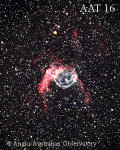 A Wolf-Rayet Star Bubble
26.08.1996
What's a Wolf-Rayet star, and how did it create that spherical bubble and sweeping arc? A Wolf-Rayet star is a star that originated with a mass over 40 times that of our Sun.
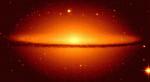 M104: The Sombrero Galaxy
8.02.1997
The famous Sombrero galaxy (M104) is a bright nearby spiral galaxy. The prominent dust lane and halo of stars and globular clusters give this galaxy its name. Something very energetic is going on in the Sombrero's center, as much X-ray light has been detected from it.
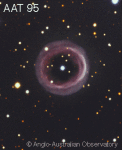 Shapley 1: An Annular Planetary Nebula
12.12.1995
This strange structure is what can result when a normal star runs out of nuclear fuel in its core. At that time, the center condenses into a white dwarf while the outer atmospheric layers are expelled into space and appear as a planetary nebula.
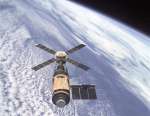 Skylab Over Earth
18.08.2013
Skylab was an orbiting laboratory launched by a Saturn V rocket in May 1973. Skylab, pictured above, was visited three times by NASA astronauts who sometimes stayed as long as two and a half months. Many scientific tests were performed on Skylab, including astronomical observations in ultraviolet and X-ray light.
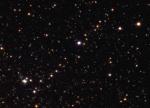 Kembles Cascade
5.12.2004
A picturesque chain of unrelated stars is visible with strong binoculars towards the constellation of Camelopardalis. Known as Kemble's Cascade, the asterism contains about 20 stars nearly in a row stretching over five times the width of a full moon.
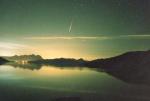 Dawn of the Leonids
22.12.1998
Many of the 1998 Leonid shower meteors were so bright they could be seen even during sunrise. The above photograph was taken near the dawn of November 16 close to Hong Kong, China. However, most meteors are fainter and are not associated with any particular meteor shower.
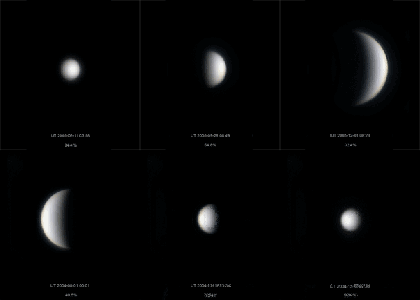 The Phases of Venus
10.01.2006
Venus goes through phases. Just like our Moon, Venus can appear as full as a disk or as a thin as a crescent. Venus, frequently the brightest object in the post-sunset or pre-sunrise sky, appears so small, however, that it usually requires binoculars or a small telescope to clearly see its current phase.
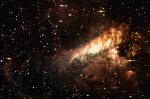 M17: The Omega Nebula
26.01.1999
The Omega Nebula contains glowing gas, dark dust, and some unusually massive stars. Also known as the M17 and the Swan Nebula, the Omega Nebula is about 5000 light-years away, 20 light-years across, and visible with binoculars in the constellation of Sagittarius.
|
January February March April May June July August |
||||||||||||||||||||||||||||||||||||||||||||||||||||||||