
|
You entered: image
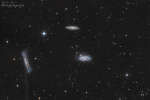 The Leo Trio
18.04.2019
This group is popular in the northern spring. Famous as the Leo Triplet, the three magnificent galaxies gather in one field of view. Crowd pleasers when imaged with even modest telescopes, they can be introduced individually as NGC 3628 (left), M66 (bottom right), and M65 (top).
 The Long Tails of Comet NEOWISE
16.07.2020
This Comet NEOWISE (C/2020 F3) now sweeps through our fair planet's northern skies. Its long tails stretch across this deep skyview from Suchy Vrch, Czech Republic. Recorded on the night of July 13/14...
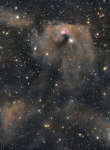 T Tauri and Hind s Variable Nebula
10.02.2022
The star with an orange tint near top center in this dusty telescopic frame is T Tauri, prototype of the class of T Tauri variable stars. Next to it (right) is a yellow cosmic cloud historically known as Hind's Variable Nebula (NGC 1555).
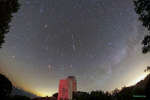 Tau Herculids Meteors over Kitt Peak Telescopes
1.06.2022
It wasn't the storm of the century -- but it was a night to remember. Last night was the peak of the Tau Herculids meteor shower, a usually modest dribble of occasional meteors originating from the disintegrating Comet 73P/Schwassmann-Wachmann 3.
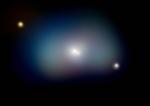 NGC 1700: Elliptical Galaxy and Rotating Disk
16.01.2003
In spiral galaxies, majestic winding arms of young stars and interstellar gas and dust rotate in a disk around a bulging galactic nucleus. Elliptical galaxies seem to be simpler, randomly swarming with old stars and lacking gas and dust.
 The Seasons of Saturn
5.04.2003
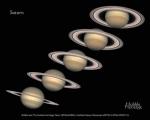
Since Saturn's axis is tilted as it orbits the Sun, Saturn has seasons, like those of planet Earth ... but Saturn's seasons last for over seven years. So what season is it on Saturn now? Orbiting the equator, the tilt of the rings of Saturn provides quite a graphic seasonal display.
 The Planetary Nebula Show
14.06.2003
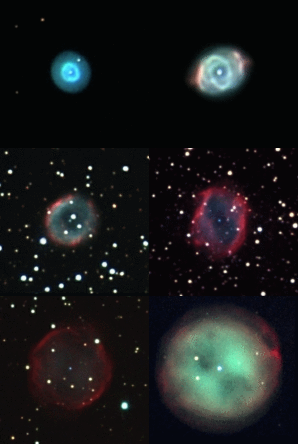
What do the Owl, the Cat's Eye, the Ghost of Jupiter, and Saturn have in common? They're all planetary nebulae of course, glowing gaseous shrouds shed by dying sun-like stars as they run out of nuclear fuel.
 Twistin' by the Lagoon
23.01.1997
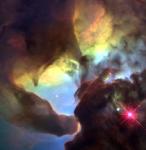
The awesome spectacle of starbirth produces extreme stellar winds and intense energetic starlight -- bombarding dusty molecular clouds inside the Lagoon Nebula (M8). At least two long funnel shaped clouds, each roughly half a light-year long, have apparently been formed by this activity.
 Recycling Cassiopeia A
30.08.2003
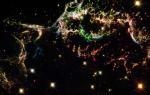
For billions of years, massive stars in our Milky Way Galaxy have lived spectacular lives. Collapsing from vast cosmic clouds, their nuclear furnaces ignite and create heavy elements in their cores. After a few million years, the enriched material is blasted back into interstellar space where star formation begins anew.
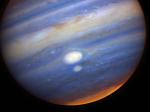 Jupiters Two Largest Storms Nearly Collide
25.07.2006
Two storms systems larger than Earth are nearly colliding right now on planet Jupiter. No one was sure what would happen, but so far both storms have survived. In the above false-color infrared image...
|
January February March April May June July August September |
|||||||||||||||||||||||||||||||||||||||||||||||||