
|
You entered: image
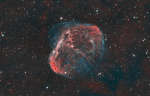 NGC 6888: The Crescent Nebula
17.06.2021
NGC 6888, also known as the Crescent Nebula, is a about 25 light-years across blown by winds from its central, bright, massive star. A triumvirate of astroimagers ( Joe, Glenn, Russell) created this sharp portrait of the cosmic bubble.
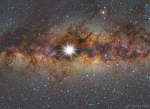 Solstice Sun and Milky Way
21.12.2021
Welcome to December's solstice, first day of winter in the north and summer for the southern hemisphere. Astronomical markers of the seasons, solstice and equinox dates are based on the Sun's place in its annual journey along the ecliptic, through planet Earth's sky.
 The Shadow of Ingenuity s Damaged Rotor Blade
10.02.2024
On January 18, 2024, during its 72nd flight in the thin Martian atmosphere, autonomous Mars Helicopter Ingenuity rose to an altitude of 12 meters (40 feet) and hovered for 4.5 seconds above the Red Planet. Ingenuity's 72nd landing was a rough one though.
 APOD: 2024 August 13 Б Giant Jet from the International Space Station
13.08.2024
What's that on the horizon? When circling the Earth on the International Space Station early last month, astronaut Matthew Dominick saw an unusual type of lightning just beyond the Earth's edge: a gigantic jet. The powerful jet appears on the left of the featured image in red and blue.
 APOD: 2025 March 11 Б NGC 1672: Barred Spiral Galaxy from Hubble
11.03.2025
Many spiral galaxies have bars across their centers. Even our own Milky Way Galaxy is thought to have a modest central bar. Prominently barred spiral galaxy NGC 1672, featured here, was captured in spectacular detail in an image taken by the orbiting Hubble Space Telescope.
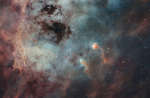 APOD: 2026 March 17 Б The Tadpoles of IC 410
17.03.2026
This telescopic close-up shows off the central regions of otherwise faint emission nebula IC 410, captured under backyard skies. Presented in a Hubble color palette, the image combines visible broadband and narrowband data with data from the near-infrared. Below and right of center are two remarkable inhabitants of the interstellar pond of gas and dust.
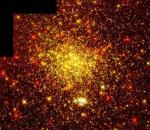 NGC1850: Star Cluster in the LMC
29.07.2000
NGC1850 is a large cluster of stars located a mere 166,000 light-years from Earth in our neighboring galaxy the Large Magellanic Cloud (LMC). The colors in this beautiful Hubble Space Telescope composite image of the cluster reveal different populations of stars.
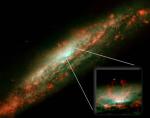 The Bubbling Cauldron of NGC 3079
22.08.2001
Edge-on spiral galaxy NGC 3079 is a mere 50 million light-years away toward the constellation Ursa Major. Shown in this stunning false-color Hubble Space Telescope image, the galaxy's disk - composed of spectacular star clusters in winding spiral arms and dramatic dark lanes of dust - spans some 70,000 light-years.
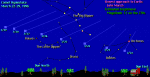 Where to See Comet Hyakutake
22.03.1996
People the world over are preparing to witness the closest approach of the brightest comet of the past twenty years. Comet Hyakutake, discovered just two months ago, will pass nearest the Earth Monday morning. All during the coming week, Comet Hyakutake will be visible in the northern sky as an unusual extended fuzzy patch.
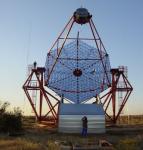 HESS Gamma Ray Telescope
6.09.2002
Most ground-based telescopes with lenses and mirrors are hindered by the Earth's nurturing, protective atmosphere that blurs images and scatters and absorbs light. But this telescope was designed to detect extreme gamma rays - photons with over 100 billion times the energy of visible light - and actually requires the atmosphere to operate.
|
January February March April May June July August September |
|||||||||||||||||||||||||||||||||||||||||||||||||