
|
You entered: Sagittarius
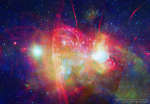 The Galactic Center from Radio to X ray
31.03.2020
In how many ways does the center of our Galaxy glow? This enigmatic region, about 26,000 light years away toward the constellation of the Archer (Sagittarius), glows in every type of light that we can see.
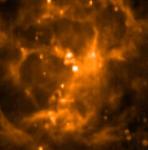 Infrared Trifid
28.08.1997
The Trifid nebula (M20) is a bright star forming region in Sagittarius, 5000 light years from Earth. In visible light, the interstellar gas cloud is crossed by dark, obscuring dust lanes which roughly divide the glowing emission nebula into three major parts.
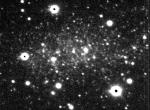 The Aquarius Dwarf
27.07.2003
Our Milky Way Galaxy is not alone. It is part of a gathering of about 50 galaxies known as the Local Group. Members include the Great Andromeda Galaxy (M31), M32, M33, the Large Magellanic Cloud, the Small Magellanic Cloud, Dwingeloo 1, several small irregular galaxies, and many dwarf elliptical and dwarf spheroidal galaxies.
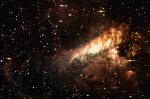 M17: The Omega Nebula
26.01.1999
The Omega Nebula contains glowing gas, dark dust, and some unusually massive stars. Also known as the M17 and the Swan Nebula, the Omega Nebula is about 5000 light-years away, 20 light-years across, and visible with binoculars in the constellation of Sagittarius.
 M8: The Lagoon Nebula
7.07.1998
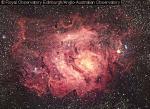
The bright Lagoon Nebula is home to a diverse array of astronomical objects. Particularly interesting sources include a bright open cluster of stars and several energetic star-forming regions. The general red glow is caused by luminous hydrogen gas, while the dark filaments are caused by absorption by dense lanes of dust.
 The Annotated Galactic Center
11.11.1997
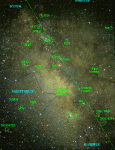
The sky toward the center of our Galaxy is filled with a wide variety of celestial wonders. Most are visible with only binoculars. Constellations of nearby stars include Sagittarius, Libra, Scorpius, Scutum, and Ophiuchus. Nebulae include Messier Objects M8, M16, M17, M20 and the Pipe Nebula.
 Milky Way Road Trip
5.09.2008
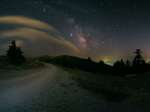
In search of planets and the summer Milky Way, astronomer Tunç Tezel took an evening road trip. Last Saturday, after driving the winding road up Uludag, a mountain near Bursa, Turkey, he was rewarded by this beautiful skyview to the south.
 The Annotated Galactic Center
29.12.2001
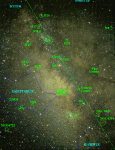
The sky toward the center of our Galaxy is filled with a wide variety of celestial wonders. Many are easily visible with binoculars. Constellations near the galactic center include Sagittarius, Libra, Scorpius, Scutum, and Ophiuchus. Nebulae include Messier Objects M8, M16, M17, M20 and the Pipe Nebula.
 The Annotated Galactic Center
11.09.1999
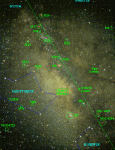
The sky toward the center of our Galaxy is filled with a wide variety of celestial wonders. Many are easily visible with binoculars. Constellations near the galactic center include Sagittarius, Libra, Scorpius, Scutum, and Ophiuchus. Nebulae include Messier Objects M8, M16, M17, M20 and the Pipe Nebula.
 Nearby Dwarf Galaxy Leo I
3.10.1999
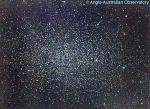
Leo I is a dwarf spheroidal galaxy in the Local Group of galaxies dominated by our Milky Way Galaxy and M31. Leo I is thought to be the most distant of the eleven known small satellite galaxies orbiting our Milky Way Galaxy.
|
January February March April May June July August September October |
|||||||||||||||||||||||||||||||||||||||||||||||||