
|
You entered: Sagittarius
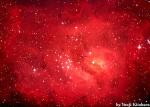 M8: In the Center of the Lagoon Nebula
3.01.2001
In the center of the Lagoon Nebula one finds glowing gas, star clusters, and dense knots of gas and dust just now forming stars. The young open cluster of stars, designated NGC 6523, can be seen in the center of the above image. These stars emit energetic light that ionizes the surrounding hydrogen gas.
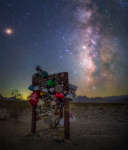 The Teapot and the Milky Way
20.07.2018
The recognizable stars of the Teapot asterism in the constellation Sagittarius posed with the Milky Way over Death Valley, planet Earth on this quiet, dark night. The surreal scene was appropriately captured from Teakettle Junction, marked by the wooden sign adorned with terrestrial teapots and kettles on the rugged road to Racetrack Playa.
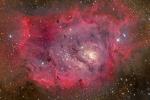 The Lagoon Nebula in Gas, Dust, and Stars
16.07.2007
Stars are battling gas and dust in the Lagoon Nebula but the photographers are winning. Also known as M8, this photogenic nebula is visible even without binoculars towards the constellation of Sagittarius. The energetic processes of star formation create not only the colors but the chaos.
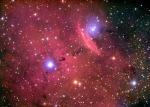 Emission and Reflection in NGC 6559
23.10.2001
Bright gas and dark dust permeate the space between stars in a nebula known as NGC 6559. The gas, primarily hydrogen, is responsible for the diffuse red glow of the emission nebula. As energetic...
 Pyrenees Paraselene
11.06.2009
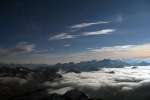
A sea of clouds laps at rugged moutain peaks of the French Pyrenees in this serene view from Pic du Midi Observatory. The time exposure was recorded on June 4, with the constellations Sagittarius and Scorpius shining in the starry night. At the top right lies a faint, but colorful moondog or paraselene.
 Near the Center of the Lagoon Nebula
4.11.2019
Stars are battling gas and dust in the Lagoon Nebula but the photographers are winning. Also known as M8, this photogenic nebula is visible even without binoculars towards the constellation of the Archer (Sagittarius). The energetic processes of star formation create not only the colors but the chaos.
 M20: The Trifid Nebula
31.03.1998
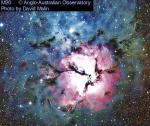
Unspeakable beauty and unimaginable bedlam can be found together in the Trifid Nebula. Also known as M20, this photogenic nebula is visible with good binoculars in the constellation of Sagittarius. The energetic processes of star formation create not only the colors but the chaos. The red-glowing gas results from high-energy light striking interstellar hydrogen gas.
 The Deep Lagoon
28.09.2023
Ridges of glowing interstellar gas and dark dust clouds inhabit the turbulent, cosmic depths of the Lagoon Nebula. Also known as M8, The bright star forming region is about 5,000 light-years distant. It makes for a popular stop on telescopic tours of the constellation Sagittarius toward the center of our Milky Way Galaxy.
 Starbirth in the Trifid Nebula
7.06.1999
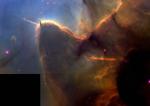
Tremendous pillars of gas and dust are being boiled away in the Trifid Nebula. In the center of the picturesque Trifid lies a young hot star, located above and to the right of this picture. As soon as it was born, the massive star scorched its surroundings with bright and
 Stars and Dust through Baade s Window
19.12.2007
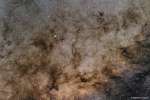
Billions of stars light up the direction toward the center of our Galaxy. The vast majority of these stars are themselves billions of years old, rivaling their home Milky Way Galaxy in age. Together with interstellar dust, these old stars combine to create this yellowish starscape.
|
January February March April May June July August September October |
|||||||||||||||||||||||||||||||||||||||||||||||||