
|
You entered: filaments
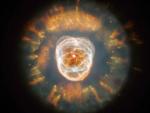 The Eskimo Nebula from Hubble
7.04.2002
In 1787, astronomer William Herschel discovered the Eskimo Nebula. From the ground, NGC 2392 resembles a person's head surrounded by a parka hood. In 2000, the Hubble Space Telescope imaged the Eskimo Nebula. From space, the nebula displays gas clouds so complex they are not fully understood.
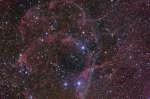 Vela Supernova Remnant
31.12.2014
The plane of our Milky Way Galaxy runs through this complex and beautiful skyscape. At the northwestern edge of the constellation Vela (the Sails) the telescopic frame is over 10 degrees wide, centered on the brightest glowing filaments of the Vela Supernova Remnant, an expanding debris cloud from the death explosion of a massive star.
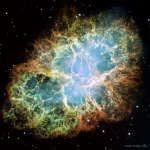 M1: The Crab Nebula from Hubble
15.08.2015
This is the mess that is left when a star explodes. The Crab Nebula, the result of a supernova seen in mysterious filaments. The filaments are not only tremendously complex, but appear to have less mass than expelled in the original supernova and a higher speed than expected from a free explosion.
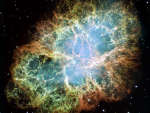 M1: The Crab Nebula from Hubble
16.02.2008
This is the mess that is left when a star explodes. The Crab Nebula, the result of a supernova seen in 1054 AD, is filled with mysterious filaments. The filaments are not only tremendously...
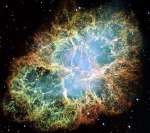 M1: The Crab Nebula from Hubble
25.10.2009
This is the mess that is left when a star explodes. The Crab Nebula, the result of a supernova seen in 1054 AD, is filled with mysterious filaments. The filaments are not only tremendously...
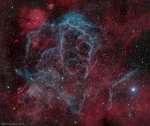 Vela Supernova Remnant
10.09.2010
The plane of our Milky Way Galaxy runs through this complex and beautiful skyscape. At the northwestern edge of the constellation Vela (the Sails) the four frame mosaic is over 10 degrees wide, centered on the glowing filaments of the Vela Supernova Remnant, the expanding debris cloud from the death explosion of a massive star.
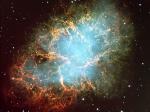 The Crab Nebula from VLT
24.03.2001
The Crab Nebula, filled with mysterious filaments, is the result of a star that was seen to explode in 1054 AD. This spectacular supernova explosion was recorded by Chinese and (quite probably) Anasazi Indian astronomers.
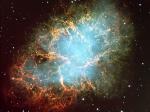 The Crab Nebula from VLT
14.07.2002
The Crab Nebula, filled with mysterious filaments, is the result of a star that was seen to explode in 1054 AD. This spectacular supernova explosion was recorded by Chinese and (quite probably) Anasazi Indian astronomers.
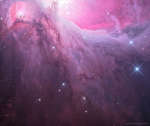 M43: Orion Falls
11.12.2018
Is there a waterfall in Orion? No, but some of the dust in M43 appears similar to a waterfall on Earth. M43, part of the Orion Molecular Cloud Complex, is the often imaged but rarely mentioned neighbor of the more famous M42.
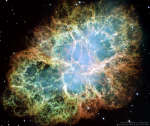 APOD: 2023 January 15 Б M1: The Crab Nebula from Hubble
14.01.2023
This is the mess that is left when a star explodes. The Crab Nebula, the result of a supernova seen in 1054 AD, is filled with mysterious filaments. The filaments are not only tremendously...
|
January February March April May June July August September |
|||||||||||||||||||||||||||||||||||||||||||||||||