
|
You entered: filaments
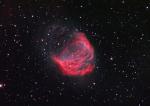 The Medusa Nebula
23.11.2007
Braided, serpentine filaments of glowing gas suggest this nebula's popular name, The Medusa Nebula. Also known as Abell 21, this Medusa is an old planetary nebula some 1,500 light-years away in the constellation Gemini. Like its mythological namesake, the nebula is associated with a dramatic transformation.
 The Medusa Nebula
25.10.2012
Braided, serpentine filaments of glowing gas suggest this nebula's popular name, The Medusa Nebula. Also known as Abell 21, this Medusa is an old planetary nebula some 1,500 light-years away in the constellation Gemini. Like its mythological namesake, the nebula is associated with a dramatic transformation.
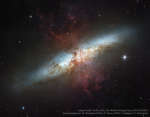 M82: Galaxy with a Supergalactic Wind
21.02.2016
What's lighting up the Cigar Galaxy? M82, as this irregular galaxy is also known, was stirred up by a recent pass near large spiral galaxy M81. This doesn't fully explain the source of the red-glowing outwardly expanding gas, however.
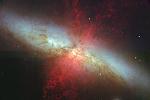 A Superwind from the Cigar Galaxy
23.11.2003
What's lighting up the Cigar Galaxy? M82, as this irregular galaxy is also known, was stirred up by a recent pass near large spiral galaxy M81. This doesn't fully explain the source of the red-glowing outwardly expanding gas, however.
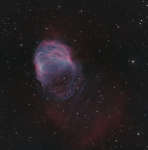 The Medusa Nebula
17.03.2023
Braided and serpentine filaments of glowing gas suggest this nebula's popular name, The Medusa Nebula. Also known as Abell 21, this Medusa is an old planetary nebula some 1,500 light-years away in the constellation Gemini. Like its mythological namesake, the nebula is associated with a dramatic transformation.
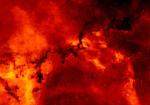 Hydrogen and Dust in the Rosette Nebula
23.12.2005
At the edge of a large molecular cloud in Monoceros, some 3,000 light years away, dark filaments of dust are silhouetted by luminous hydrogen gas. The close up view of the Rosette Nebula...
 The Tarantula Zone
26.04.2008
The Tarantula Nebula is more than 1,000 light-years in diameter -- a giant star forming region within our neighboring galaxy the Large Magellanic Cloud (LMC). That cosmic arachnid lies at the upper left of this expansive mosiac covering a part of the LMC over 6,000 light-years across.
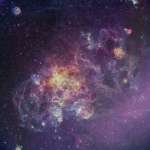 The Tarantula Zone
16.09.2009
The Tarantula Nebula is more than 1,000 light-years in diameter -- a giant star forming region within our neighboring galaxy the Large Magellanic Cloud (LMC). That cosmic arachnid lies left of center in this in this colorful telescopic image taken through narrow-band filters. It covers a part of the LMC over 2,000 light-years across.
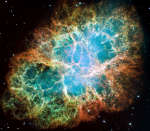 M1: The Crab Nebula from Hubble
25.12.2011
This is the mess that is left when a star explodes. The Crab Nebula, the result of a supernova seen in 1054 AD, is filled with mysterious filaments. The filaments are not only tremendously complex, but appear to have higher speed than expected from a free explosion.
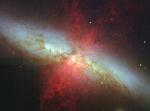 A Superwind from the Cigar Galaxy
4.04.2000
What's lighting up the Cigar Galaxy? M82, as this irregular galaxy is also known, was stirred up by a recent pass near large spiral galaxy M81. This doesn't fully explain the source of the red-glowing outwardly expanding gas, however.
|
January February March April May June July August September |
|||||||||||||||||||||||||||||||||||||||||||||||||