
|
You entered: filaments
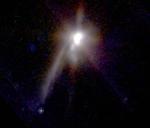 An Extrasolar Planet?
29.05.1998
This infrared Hubble Space Telescope view may contain the first ever direct image of a planet outside our own solar system. The picture shows a very young double star located about 450 light-years away toward the constellation of Taurus.
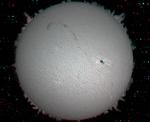 A Stereo Sun
26.11.2005
A stereo view of the closest star, this creatively composited image was constructed from an extensive archive of pictures taken between March 2004 and April 2005. When viewed with red/blue glasses, the Sun's disk and surface features, including sunspots, filaments, and prominences, stand out in an exaggerated stereo perspective.
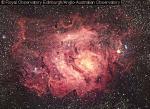 M8: The Lagoon Nebula
7.07.1998
The bright Lagoon Nebula is home to a diverse array of astronomical objects. Particularly interesting sources include a bright open cluster of stars and several energetic star-forming regions. The general red glow is caused by luminous hydrogen gas, while the dark filaments are caused by absorption by dense lanes of dust.
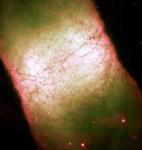 IC 4406: A Seemingly Square Nebula
27.04.1998
How can a round star make a square nebula? This conundrum came to light with the discovery of planetary nebulae like IC 4406. IC 4406 is most probably cylindrical, with its square appearance the result of our vantage point in viewing the cylinder.
 A Slice Through an Artificial Universe
23.06.1998
We live in the era of humanity when most of our Universe is being mapped. To help understand these maps, astronomers computationally estimate the appearance of several possible candidate universes, to which maps of the real Universe can be compared.
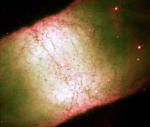 IC 4406: A Seemingly Square Nebula
16.04.2000
How can a round star make a square nebula? This conundrum came to light with the discovery of planetary nebulae like IC 4406. IC 4406 is most probably cylindrical, with its square appearance the result of our vantage point in viewing the cylinder.
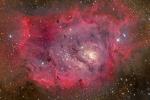 The Lagoon Nebula in Gas, Dust, and Stars
16.07.2007
Stars are battling gas and dust in the Lagoon Nebula but the photographers are winning. Also known as M8, this photogenic nebula is visible even without binoculars towards the constellation of Sagittarius. The energetic processes of star formation create not only the colors but the chaos.
 APOD: 2024 July 29 Б Milky Way over Uluru
29.07.2024
What's happening above Uluru? A United Nations World Heritage Site, Uluru is an extraordinary 350-meter high mountain in central Australia that rises sharply from nearly flat surroundings. Composed of sandstone, Uluru has slowly formed over the past 300 million years as softer rock eroded away.
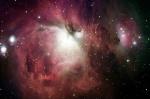 The Orion Nebula in Hydrogen
22.11.2000
The Great Nebula in Orion can be found just below and to the left of the easily identifiable belt of three stars in the popular constellation Orion. This fuzzy patch, visible to the unaided eye, contains one of the closest stellar nurseries, lying at a distance of about 1500 light years.
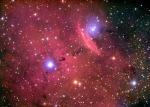 Emission and Reflection in NGC 6559
23.10.2001
Bright gas and dark dust permeate the space between stars in a nebula known as NGC 6559. The gas, primarily hydrogen, is responsible for the diffuse red glow of the emission nebula. As energetic...
|
January February March April May June July August September |
|||||||||||||||||||||||||||||||||||||||||||||||||