
|
You entered: filaments
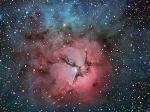 The Trifid Nebula in Stars and Dust
13.08.2007
Unspeakable beauty and unimaginable bedlam can be found together in the Trifid Nebula. Also known as M20, this photogenic nebula is visible with good binoculars towards the constellation of Sagittarius. The energetic processes of star formation create not only the colors but the chaos. The red-glowing gas results from high-energy starlight striking interstellar hydrogen gas.
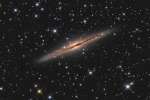 Edge on Spiral Galaxy NGC 891
25.02.2010
This beautiful cosmic portrait features NGC 891. The spiral galaxy spans about 100 thousand light-years and is seen almost exactly edge-on from our perspective. In fact, about 30 million light-years distant in the constellation Andromeda, NGC 891 looks a lot like our Milky Way.
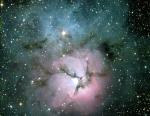 M20: The Trifid Nebula
28.03.2000
Unspeakable beauty and unimaginable bedlam can be found together in the Trifid Nebula. Also known as M20, this photogenic nebula is visible with good binoculars towards the constellation of Sagittarius. The energetic processes of star formation create not only the colors but the chaos. The red-glowing gas results from high-energy starlight striking interstellar hydrogen gas.
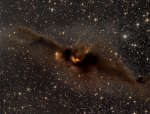 LDN 43: The Cosmic Bat Nebula
31.10.2022
What is the most spook-tacular nebula in the galaxy? One contender is LDN 43, which bears an astonishing resemblance to a vast cosmic bat flying amongst the stars on a dark Halloween night. Located...
 N159 and the Papillon Nebula
21.12.2003
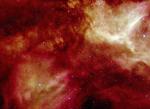
In a search for massive stars, the Hubble Space Telescope has peered into yet another spectacular region of star formation. This nebula, known as N159, spans over 150 light-years and is located in the neighboring Large Magellanic Cloud galaxy, about 170,000 light years distant.
 Infrared Trifid
13.01.2005
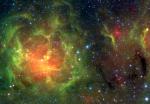
The Trifid Nebula, aka M20, is easy to find with a small telescope, a well known stop in the nebula rich constellation Sagittarius. But where visible light pictures show the nebula divided into three parts by dark, obscuring dust lanes, this penetrating infrared image reveals filaments of luminous gas and newborn stars.
 The Galactic Center Radio Arc
3.04.2005
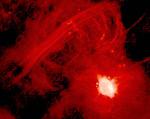
What causes this unusual structure near the center of our Galaxy? The long parallel rays slanting across the top of the above radio image are known collectively as the Galactic Center Radio Arc and jut straight out from the Galactic plane.
 The Galactic Center Radio Arc
27.04.2008
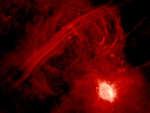
What causes this unusual structure near the center of our Galaxy? The long parallel rays slanting across the top of the above radio image are known collectively as the Galactic Center Radio Arc and jut straight out from the Galactic plane.
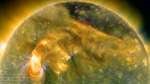 The Not So Quiet Sun
6.08.2010
After a long solar minimum, the Sun is no longer so quiet. On August 1, this extreme ultraviolet snapshot of the Sun from the Solar Dynanimcs Observatory captured a complex burst of activity playing across the Sun's northern hemisphere.
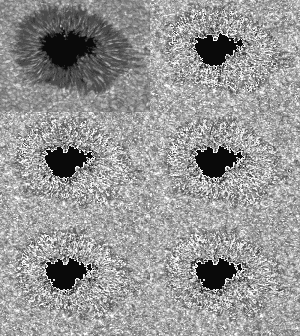 Sunspot Seething
23.02.2000
Our Sun's surface is continually changing. This time-lapse movie shows in five seconds what happens in 20 minutes on the Sun's surface near a sunspot. Visible is boiling granulation outside the sunspot...
|
January February March April May June July August September |
|||||||||||||||||||||||||||||||||||||||||||||||||