
|
You entered: filaments
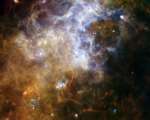 Herschel Views the Milky Way
2.09.2011
With a 3.5 meter diameter mirror, larger than the Hubble Space Telescope, ESA's Herschel Space Observatory explores the Universe at infrared wavelengths. Herschel is named for German-born British astronomer Frederick William Herschel who discovered infrared light over 200 years ago.
 APOD: 2024 January 14 Б Dragon Aurora over Iceland
14.01.2024
Have you ever seen a dragon in the sky? Although real flying dragons don't exist, a huge dragon-shaped aurora developed in the sky over Iceland in 2019. The aurora was caused...
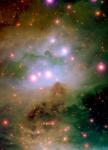 The Colorful Orion Nebula
14.09.1999
The Great Nebula in Orion is a colorful place. Visible to the unaided eye as a fuzzy patch in the constellation of Orion, this image taken with the Big Throughput Camera shows the Orion Nebula to be a busy neighborhood of young stars, hot gas, and dark dust.
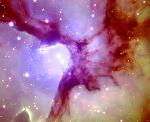 In the Center of the Trifid Nebula
26.06.2002
Clouds of glowing gas mingle with lanes of dark dust in the Trifid Nebula, a star forming region toward the constellation of Sagittarius. In the center, the three huge dark dust lanes that give the Trifid its name all come together.
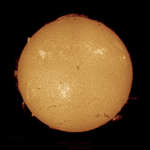 Perihelion Sun 2023
14.01.2023
Perihelion for 2023, Earth's closest approach to the Sun, was on January 4 at 16:17 UTC. That was less than 24 hours after this sharp image of the Sun's disk was recorded with telescope and H-alpha filter from Sidney, Australia, planet Earth.
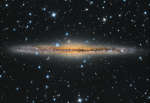 Edge On NGC 891
12.01.2017
Large spiral galaxy NGC 891 spans about 100 thousand light-years and is seen almost exactly edge-on from our perspective. In fact, about 30 million light-years distant in the constellation Andromeda, NGC 891 looks a lot like our Milky Way.
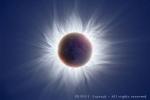 The Big Corona
15.09.1999
Most photographs don't adequately portray the magnificence of the Sun's corona. Seeing the corona first-hand during a total solar eclipse is best. The human eye can adapt to see features and extent that photographic film usually cannot. Welcome, however, to the digital age.
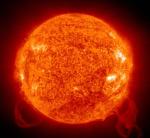 Double Eruptive Prominences
18.04.2003
Lofted over the Sun on looping magnetic fields, large solar prominences are composed of relatively cool, dense plasma. When seen against the brilliant solar disk they appear as dark filaments, but these enormous magnetic...
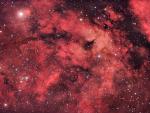 A Cygnus Star Field
28.07.2004
In the constellation of the swan near the nebula of the pelican lies the gas cloud of the butterfly surrounding a star known as the hen. That star, given the proper name Sadr, is visible to the unaided eye but found here as the brightest object on the upper left.
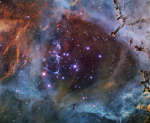 In the Heart of the Rosette Nebula
11.03.2014
In the heart of the Rosette Nebula lies a bright open cluster of stars that lights up the nebula. The stars of NGC 2244 formed from the surrounding gas only a few million years ago.
|
January February March April May June July August September |
|||||||||||||||||||||||||||||||||||||||||||||||||