
|
You entered: filaments
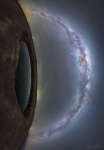 Eye on the Milky Way
21.04.2020
Have you ever had stars in your eyes? It appears that the eye on the left does, and moreover it appears to be gazing at even more stars. The featured 27-frame mosaic was taken last July from Ojas de Salar in the Atacama Desert of Chile.
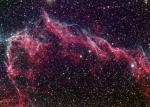 NGC 6992: A Glimpse of the Veil
28.09.2001
After 5,000 years, the gorgeous Veil Nebula is still turning heads. Cataloged as NGC 6992, these glowing filaments of interstellar shocked gas are part of a larger spherical supernova remnant known as the Cygnus Loop or the Veil Nebula -- expanding debris from a star which exploded over 5,000 years ago.
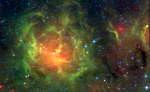 Infrared Trifid
31.12.2016
The Trifid Nebula, also known as Messier 20, is easy to find with a small telescope, a well known stop in the nebula rich constellation Sagittarius. But where visible light pictures show the nebula...
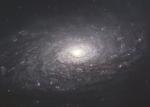 M63: The Sunflower Galaxy
27.06.2000
One of the bright spiral galaxies visible in the north sky is M63, the Sunflower Galaxy. M63, also catalogued as NGC 5055, can be found with a small telescope in the constellation of Canes Venaciti.
 A Slice of the Universe with 2dF
14.06.2000
What can 100,000 galaxies tell you? Perhaps the structure and composition of the universe. Astronomers using the Two Degree Field (2dF) spectrograph on the Anglo-Australian Telescope (AAT) in Australia have now measured the redshifts of over 100,000 galaxies in a thin ribbon of the sky.
 A Double Eclipse of the Sun
21.03.2015
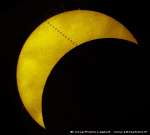
Can the Sun be eclipsed twice at the same time? Last Friday was noteworthy because part of the Earth was treated to a rare total eclipse of the Sun. But also on Friday, from...
 APOD: 2023 August 1 Б Monster Solar Prominence
1.08.2023
The monsters that live on the Sun are not like us. They are larger than the Earth and made of gas hotter than in any teapot. They have no eyes, but at times, many tentacles. They float. Usually, they slowly change shape and just fade back onto the Sun over about a month.
 The Early Universe
16.02.1996
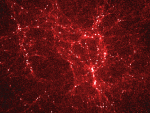
What did our universe look like when it was young? To answer this, cosmologists run sophisticated computer programs tracking the locations of millions of particles. The above animated frame is the result of such a calculation and shows how our universe might have looked when it was just a fracton of its current age.
 The Trifid Nebula from CFHT
31.05.2005
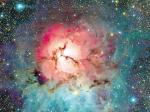
Unspeakable beauty and unimaginable bedlam can be found together in the Trifid Nebula. Also known as M20, this photogenic nebula is visible with good binoculars towards the constellation of Sagittarius. The energetic processes of star formation create not only the colors but the chaos. The red-glowing gas results from high-energy starlight striking interstellar hydrogen gas.
 M8: The Lagoon Nebula
10.02.2006
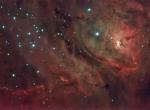
This beautiful cosmic cloud is a popular stop on telescopic tours of the constellation Sagittarius. Eighteenth century cosmic tourist Charles Messier cataloged the bright nebula as M8, while modern day astronomers recognize the Lagoon...
|
January February March April May June July August September |
|||||||||||||||||||||||||||||||||||||||||||||||||