
|
You entered: filaments
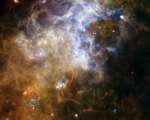 Herschel Views the Milky Way
16.10.2009
With a 3.5 meter diameter mirror, larger than the Hubble Space Telescope, Herschel is ESA's new infrared observatory. The space-based telescope is named for German-born British astronomer Frederick William Herschel who discovered infrared light over 200 years ago.
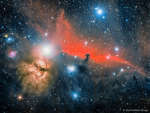 The Horsehead Nebula
6.10.2019
The Horsehead Nebula is one of the most famous nebulae on the sky. It is visible as the dark indentation to the red emission nebula in the center of the above photograph. The horse-head feature is dark because it is really an opaque dust cloud that lies in front of the bright red emission nebula.
 APOD: 2025 September 17 Б Nebulas and Clusters in Sagittarius
17.09.2025
Can you spot famous celestial objects in this image? 18th-century astronomer Charles Messier cataloged only two of them: the bright Lagoon Nebula (M8) at the bottom, and the colorful Trifid Nebula (M20) at the upper right.
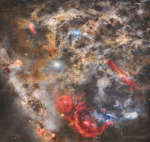 APOD: 2026 March 2 Б The Dusty Surroundings of Orion and the Pleiades
2.03.2026
How well do you know the night sky? OK, but how well can you identify famous sky objects in a very deep image? Either way, here is a test: see if you can find some well-known night-sky icons in a deep image filled with filaments of normally faint dust and gas.
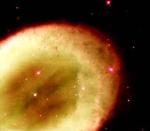 M57: The Ring Nebula
4.05.1998
It looked like a ring on the sky. Hundreds of years ago astronomers noticed a nebula with a most unusual shape. Now known as M57 or NGC 6720, the gas cloud became popularly known as the Ring Nebula.
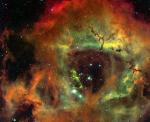 The Rosette Nebula in Hydrogen, Oxygen, and Sulfur
11.01.2000
The Rosette Nebula is a large emission nebula located 3000 light-years away. The great abundance of hydrogen gas gives NGC 2237 its red color in most photographs. The wind from the open cluster of stars known as NGC 2244 has cleared a hole in the nebula's center.
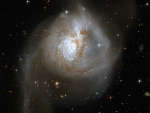 Galaxies Collide in NGC 3256
6.05.2008
Galaxies don't normally look like this. NGC 3256 actually shows a current picture of two galaxies that are slowly colliding. Quite possibly, in hundreds of millions of years, only one galaxy will remain.
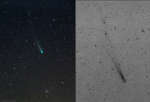 Active Comet ISON
16.11.2013
Falling through planet Earth's predawn skies toward its close encounter with the Sun on November 28, Comet ISON is coming to life. The much anticipated comet has now been reported to have substantially increased in brightness, surging to naked-eye visibility for dark sites and sprouting a more complex tail.
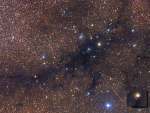 LDN 988: Dark Nebula in Cygnus
19.11.2014
Obscuring the rich starfields of northern Cygnus, dark nebula LDN 988 lies near the center of this cosmic skyscape. Composed with telescope and camera, the scene is some 2 degrees across. That corresponds to 70 light-years at the estimated 2,000 light-year distance of LDN 988.
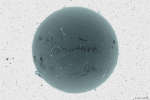 Black Sun and Inverted Starfield
19.02.2017
Does this strange dark ball look somehow familiar? If so, that might be because it is our Sun. In the featured image from 2012, a detailed solar view was captured originally in a very specific color of red light, then rendered in black and white, and then color inverted.
|
January February March April May June July August September |
|||||||||||||||||||||||||||||||||||||||||||||||||