
|
You entered: gas
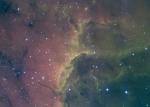 Pelican Nebula Ionization Front
3.07.2000
The Pelican Nebula is slowly being transformed. IC 5070, the official designation, is divided from the larger North America Nebula by a molecular cloud filled with dark dust. The Pelican, however, receives much study because it is a particularly active mix of star formation and evolving gas clouds.
 Near the Center of the Lagoon Nebula
3.11.2019
Stars are battling gas and dust in the Lagoon Nebula but the photographers are winning. Also known as M8, this photogenic nebula is visible even without binoculars towards the constellation of the Archer (Sagittarius). The energetic processes of star formation create not only the colors but the chaos.
 APOD: 2024 April 30 Б GK Per: Nova and Planetary Nebula
29.04.2024
The star system GK Per is known to be associated with only two of the three nebulas pictured. At 1500 light years distant, Nova Persei 1901 (GK Persei) was the second closest nova yet recorded. At the very center is a white dwarf star, the surviving core of a former Sun-like star.
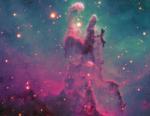 Eagle Castle
30.07.1997
What lights up this castle of star formation? The familiar Eagle Nebula glows much like a neon sign, but in many colors at once. The above photograph is a composite of three of these glowing gas colors.
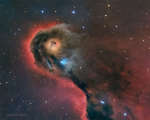 APOD: 2025 October 14 Б An Unusual Globule in IC 1396
13.10.2025
Is there a monster in IC 1396? Known to some as the Elephant's Trunk Nebula, parts of gas and dust clouds of this star formation region may appear to take on foreboding forms, some nearly human. The only real monster here, however, is a bright young star too far from Earth to hurt us.
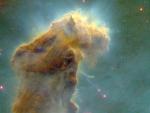 Eagle EGGs in M16
12.08.2001
Star forming regions known as "EGGs" are uncovered at the end of this giant pillar of gas and dust in the Eagle Nebula (M16). EGGs, short for evaporating gaseous globules, are dense regions of mostly molecular hydrogen gas that fragment and gravitationally collapse to form stars.
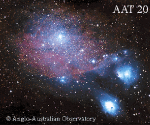 Nebulosity in Sagittarius
18.07.1996
What causes the colors in this beautiful nebulosity in Sagittarius? Dubbed NGC 6589 and NGC 6590, the colors of this nebulosity, are caused by gas and dust. The blue color of the nebula nearest the bright stars is caused by reflection off interstellar dust.
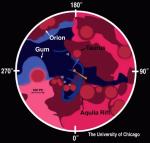 The Solar Neighborhood
24.02.1998
You are here. The orange dot in the above false-color drawing represents the current location of the Sun among local gas clouds in the spiral Milky Way Galaxy. These gas clouds are so thin that we usually see right through them. Nearly spherical bubbles surround regions of recent star formation.
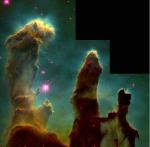 From Eagle's EGGs A Star Is Born
18.01.1997
Perhaps the most famous astronomical image in recent years reveals newborn stars upon pillars of gas and dust - uncovered as researchers used the Hubble Space Telescope to explore the Eagle Nebula in 1995. This...
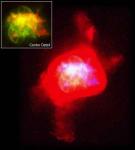 NGC 6210: The Turtle in Space Planetary Nebula
27.10.1998
A Turtle in Space? Planetary nebula NGC 6210 may look like a giant space turtle, but it is actually much more massive and violent. Fortunately, this gas cloud in Hercules lies about 6500 light years away.
|
January February March April May June July August September October |
|||||||||||||||||||||||||||||||||||||||||||||||||