
|
You entered: gas
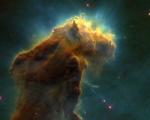 Eagle Eggs in M16
27.02.1998
Star forming regions known as "EGGs" are uncovered at the end of this giant pillar of gas and dust in the Eagle Nebula (M16). EGGs, short for evaporating gaseous globules, are dense regions of mostly molecular hydrogen gas that fragment and gravitationally collapse to form stars.
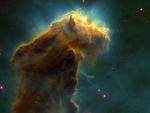 Eagle EGGs in M16
2.04.2000
Star forming regions known as "EGGs" are uncovered at the end of this giant pillar of gas and dust in the Eagle Nebula (M16). EGGs, short for evaporating gaseous globules, are dense regions of mostly molecular hydrogen gas that fragment and gravitationally collapse to form stars.
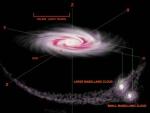 The Magellanic Stream
26.08.1998
Spanning the sky behind the majestic Clouds of Magellan is an unusual stream of gas: the Magellanic Stream. The origin of this gas might hold a clue to origin and fate of our Milky Way's most famous satellite galaxies: the LMC and the SMC.
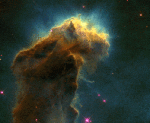 Eagle EGGs in M16
6.11.1995
Star forming regions known as "EGGs" are uncovered at the end of this giant pillar of gas and dust in the Eagle Nebula (M16). EGGs, short for evaporating gaseous globules, are dense regions of mostly molecular hydrogen gas that fragment and gravitationally collapse to form stars.
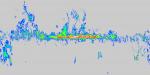 Milky Way Molecule Map
30.04.1997
Where are the Milky Way's gas clouds and where are they going? Stars form in gas clouds, and the motion of gas clouds tell us about the size and rotation speed of our own Milky Way Galaxy.
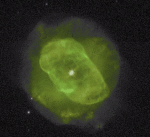 NGC 5882: A Small Planetary Nebula
28.08.1996
Will most stars one day look like this? Pictured above is the planetary nebula NGC 5882, captured by the Hubble Space Telescope. Although planetary nebulae can appear similar to planets like Uranus and Neptune, they are actually gas clouds surrounding stars typically hundreds of light years away.
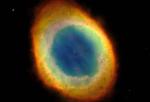 M57: The Ring Nebula
16.07.2000
Except for the rings of Saturn, The Ring Nebula (M57) is probably the most famous celestial band. This planetary nebula's simple, graceful appearance is thought to be due to perspective -- our view from planet Earth looking straight into what is actually a barrel-shaped cloud of gas shrugged off by a dying central star.
 The Ring
6.01.1999
Except for the Rings of Saturn, The Ring Nebula (M57) is probably the most famous celestial band. This planetary nebula's simple, graceful appearance is thought to be due to perspective -- our view from planet Earth looking straight into what is actually a barrel-shaped cloud of gas shrugged off by a dying central star.
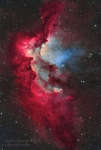 APOD: 2025 October 8 Б NGC 7380: The Wizard Nebula
7.10.2025
What powers are being wielded in the Wizard Nebula? Gravitation strong enough to form stars, and stellar winds and radiations powerful enough to create and dissolve towers of gas. Located only 8,000 light years away, the Wizard nebula, featured here, surrounds a developing open star cluster NGC 7380.
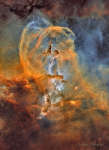 APOD: 2026 July 20 Б NGC 3576: The Statue of Liberty Nebula
19.07.2026
What's happening in the Statue of Liberty nebula? Bright stars and interesting molecules are forming and being liberated. The complex nebula resides in the star forming region called RCW 57, and besides the iconic monument, to some looks like a flying superhero or a weeping angel.
|
January February March April May June July August September October |
|||||||||||||||||||||||||||||||||||||||||||||||||