
|
You entered: clouds
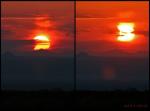 Touran Sunrise
23.03.2007
Clouds covered the eastern horizon on Monday, when the Sun rose over the expansive Touran Wildlife Reserve in northeastern Iran. Of course, on that day the Moon rose with the Sun, creating a widely enjoyed partial solar eclipse.
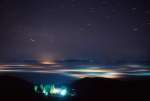 As Above, So Below
3.12.2011
A single, long exposure captured these star trails above a remarkably colorful sea of clouds. As seen from Medvednica mountain, the surrounding peaks and lights illuminating the clouds from below are north of Zagreb, Croatia.
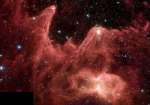 Mountains of Creation
15.12.2007
(xxxedit and linkxxx) This fantastic skyscape lies at the eastern edge of giant stellar nursery W5, about 7,000 light-years away in the constellation Cassiopeia. An infrared view from the Spitzer Space Telescope...
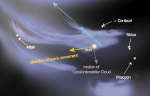 The Local Fluff
29.08.2010
The stars are not alone. In the disk of our Milky Way Galaxy about 10 percent of visible matter is in the form of gas, called the interstellar medium (ISM). The ISM is not uniform, and shows patchiness even near our Sun.
 Thackerays Globules
16.08.2003
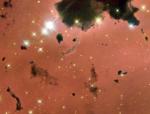
Rich star fields and glowing hydrogen gas silhouette dense, opaque clouds of interstellar gas and dust in this Hubble Space Telescope close-up of IC 2944, a bright star forming region in Centaurus, 5,900 light-years away. The largest of these dark globules, first spotted by South African astronomer A. D.
 A Partially Eclipsed Setting Sun
30.04.2014
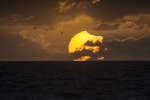
If you look closely, you will see something quite unusual about this setting Sun. There are birds flying to the Sun's left, but that's not so unusual. A dark sea covers the Sun's bottom, and dark clouds cover parts of the middle, but they are also not very unusual.
 The Sun Also Rises
15.01.2000
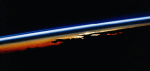
Sunrise seen from low Earth orbit can be very dramatic indeed (and the authors don't apologize to Hemingway for using his title!). In this breathtaking view from the space shuttle Endeavor, the Sun is just visible peaking over towering anvil-shaped storm clouds.
 Mysterious Acid Haze on Venus
26.02.2008
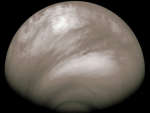
Why did an acidic haze spread across Venus? The unusual clouds were discovered last July by ESA's robotic Venus Express spacecraft currently orbiting Venus. The bright and smooth haze was found by Venus...
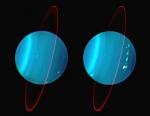 A Sharper View of a Tilted Planet
18.11.2004
These sharp views of tilted gas giant Uranus show dramatic details of the planet's atmosphere and ring system. The remarkable ground-based images were made using a near-infrared camera and the Keck Adaptive Optics system to reduce the blurring effects of Earth's atmosphere.
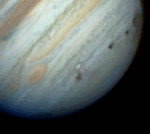 Comet Impacts on Jupiter
14.07.1995
In July of 1994, pieces of Comet Shoemaker-Levy 9, also known as the "string of pearls" comet, collided with the planet Jupiter. As the comet fragments smashed in to Jupiter, the resulting explosions scattered large quantities of dusty cometary debris into the Jovian atmosphere.
|
January February March April May June July August September October |
|||||||||||||||||||||||||||||||||||||||||||||||||