
|
You entered: clouds
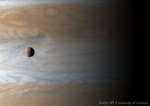 Io: Moon over Jupiter
7.08.2016
How big is Jupiter's moon Io? The most volcanic body in the Solar System, Io (usually pronounced "EYE-oh") is 3,600 kilometers in diameter, about the size of planet Earth's single large natural satellite.
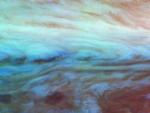 Jupiter: At The Belt-Zone Boundary
10.03.1997
Jupiter's thick atmosphere is striped by wind-driven cloud bands that remain fixed in latitude - dark colored bands are known as belts while light colored bands are zones. At Jupiter's belt-zone boundaries the shearing wind velocities can reach nearly 300 miles per hour.
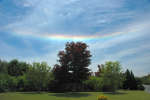 A Fire Rainbow Over New Jersey
10.06.2008
What is that inverted rainbow in the sky? Sometimes known as a fire rainbow for its flame-like appearance, a circumhorizon arc is created by ice, not fire. For a circumhorizon arc to be visible, the Sun must be at least 58 degrees high in a sky where cirrus clouds are present.
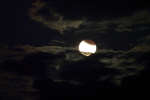 A Partial Lunar Eclipse
28.06.2010
What's happened to the Moon? This past weekend, once again, part of the Moon moved through the Earth's shadow. This happens about once or twice a year, on the average, but not each month since the Moon's orbit around the Earth is slightly tilted.
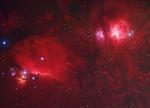 An Orion Deep Field
15.01.2004
Adrift 1,500 light-years away in one of the night sky's most recognizable constellations, the glowing Orion Nebula and the dark Horsehead Nebula are contrasting cosmic vistas. They both appear in this stunning composite digital image assembled from over 20 hours of data that includes exposures filtered to record emission from hydrogen atoms.
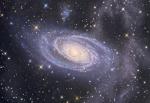 M81 in Ursa Major
27.04.2007
One of the brightest galaxies in planet Earth's sky and similar in size to the Milky Way, big, beautiful spiral M81 lies 11.8 million light-years away in the northern constellation Ursa Major. This...
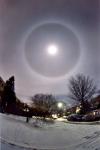 A Halo Around the Moon
21.04.2003
Have you ever seen a halo around the Moon? This fairly common sight occurs when high thin clouds containing millions of tiny ice crystals cover much of the sky. Each ice crystal acts like a miniature lens.
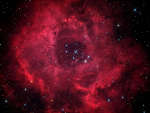 The Rosette Nebula
14.02.2012
The Rosette Nebula is not the only cosmic cloud of gas and dust to evoke the imagery of flowers -- but it is the most famous. At the edge of a large molecular cloud...
 A Dark Seahorse in Cepheus
7.11.2025
Spanning light-years, this suggestive shape known as the Seahorse Nebula floats in silhouette against a rich background of stars and glowing hydrogen gas. Seen toward the royal northern constellation of Cepheus, the dusty, dark nebula is part of a Milky Way molecular cloud some 1,200 light-years distant.
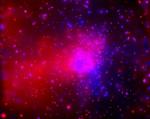 X Rays from M17
21.08.2003
About 5,000 light-years away, toward the constellation Sagittarius and the center of our galaxy, lies the bright star forming region cataloged as M17. In visible light, M17's bowed and hollowed-out appearance has resulted in many popular names like the Horseshoe, Swan, Omega, and Lobster nebula. But what has sculpted this glowing gas cloud?
|
January February March April May June July August September October |
|||||||||||||||||||||||||||||||||||||||||||||||||