
|
You entered: clouds
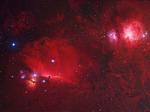 An Orion Deep Field
15.10.2006
Adrift 1,500 light-years away in one of the night sky's most recognizable constellations, the glowing Orion Nebula and the dark Horsehead Nebula are contrasting cosmic vistas. They both appear in this stunning composite digital image assembled from over 20 hours of data that includes exposures filtered to record emission from hydrogen atoms.
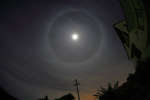 A Halo Around the Moon
20.11.2012
Have you ever seen a halo around the Moon? This fairly common sight occurs when high thin clouds containing millions of tiny ice crystals cover much of the sky. Each ice crystal acts like a miniature lens.
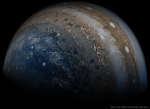 Beneath Jupiter
29.05.2017
Jupiter is stranger than we knew. NASA's Juno spacecraft has now completed its sixth swoop past Jupiter as it moves around its highly elliptical orbit. Pictured, Jupiter is seen from below where, surprisingly, the horizontal bands that cover most of the planet disappear into swirls and complex patterns.
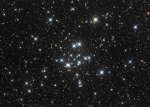 Star Cluster M34
11.02.2010
This pretty open cluster of stars, M34, is about the size of the Full Moon on the sky. Easy to appreciate in small telescopes, it lies some 1,800 light-years away in the constellation Perseus. At that distance, M34 physically spans about 15 light-years.
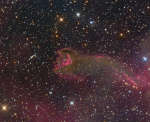 CG4: A Ruptured Cometary Globule
13.05.2014
Can a gas cloud grab a galaxy? It's not even close. The "claw" of this odd looking "creature" in the above photo is a gas cloud known as a cometary globule. This globule, however, has ruptured. Cometary globules are typically characterized by dusty heads and elongated tails.
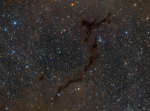 Barnard 150: Seahorse in Cepheus
25.10.2018
Light-years across, this suggestive shape known as the Seahorse Nebula appears in silhouette against a rich, luminous background of stars. Seen toward the royal northern constellation of Cepheus, the dusty, obscuring clouds are part of a Milky Way molecular cloud some 1,200 light-years distant.
 Lynds Dark Nebula 43
30.10.2025
Sure, Halloween is an astronomy holiday. But astronomers always enjoy scanning the heavens for spook-tacular galaxies, stars, and nebulae. This favorite is item number 43 from the Beverly Lynds 1962 Catalog of Dark Nebulae, fondly known as the Cosmic Bat nebula.
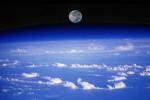 Moonset, Planet Earth
28.10.2000
During the Astro-1 astronomy mission of December, 1990, Space Shuttle astronauts photographed this stunning view of the full moon rising above the Earth's limb. In the foreground, towering clouds of condensing water vapor mark the extent of the troposphere, the lowest layer of the planet's life-sustaining atmosphere.
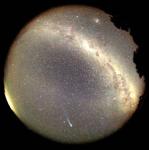 A Southern Sky View
26.02.1998
From horizon to horizon, the night sky above Loomberah, New South Wales, Australia was photographed by astronomer Gordon Garradd on March 22, 1996. Garradd used a home made all-sky camera with a fish-eye lens, resulting in a circular 200 degree field of view.
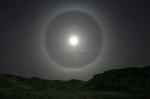 A Sun Halo over Utah
11.04.2006
Have you ever seen a halo around the Sun? This fairly common sight occurs when high thin clouds containing millions of tiny ice crystals cover much of the sky. Each ice crystal acts like a miniature lens.
|
January February March April May June July August September October |
|||||||||||||||||||||||||||||||||||||||||||||||||