
|
You entered: clouds
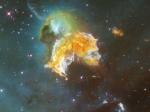 Rampaging Supernova Remnant N63A
8.06.2005
What has this supernova left behind? As little as 2,000 years ago, light from a massive stellar explosion in the Large Magellanic Clouds (LMC) first reached planet Earth. The LMC is a close...
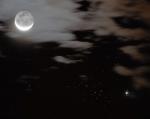 Jupiter, Moons, and Bees
25.09.2002
Rising before the Sun on September 4, Jupiter and an old cresent Moon gathered in the dim constellation of Cancer. Watching from a hillside near Austin, Texas, planet Earth, astrophotographer Russell Croman recorded this view of their passing as clouds gracefully dimmed the brilliant moonlight.
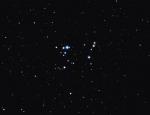 The 37 Cluster
18.11.2005
For the mostly harmless denizens of planet Earth, the brighter stars of open cluster NGC 2169 seem to form a cosmic 37. (Did you expect 42?.) Of course, the improbable numerical asterism appears solely by chance and lies at an estimated distance of 3,600 light-years toward the constellation Orion.
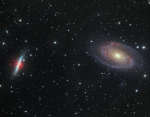 Galaxy Wars: M81 versus M82
24.03.2010
On the right, surrounded by blue spiral arms, is spiral galaxy M81. On the left, marked by red gas and dust clouds, is irregular galaxy M82. This stunning vista shows these two mammoth galaxies locked in gravitational combat, as they have been for the past billion years.
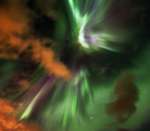 Cloudy Night of the Northern Lights
30.09.2011
On September 26, a large solar coronal mass ejection smacked into planet Earth's magnetosphere producing a severe geomagnetic storm and wide spread auroras. Captured here near local midnight from Kvaløya island outside Tromsø in northern Norway, the intense auroral glow was framed by parting rain clouds.
 Anticrepuscular Rays Over Wyoming
21.02.2012
What's happening over the horizon? Although the scene may appear somehow supernatural, nothing more unusual is occurring than a setting Sun and some well placed clouds. Pictured above are anticrepuscular rays. To understand them, start by picturing common crepuscular rays that are seen any time that sunlight pours though scattered clouds.
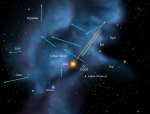 The Local Fluff
24.09.2013
The stars are not alone. In the disk of our Milky Way Galaxy about 10 percent of visible matter is in the form of gas, called the interstellar medium (ISM). The ISM is not uniform, and shows patchiness even near our Sun.
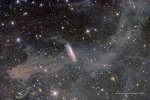 Galaxy, Stars, and Dust
12.10.2015
Is this galaxy trapped in a web of dust? No -- it is far in the background. However, spiky stars and spooky shapes are abound in this deep cosmic skyscape. Its well-composed field of view covers about a Full Moon on the sky toward the constellation Pegasus.
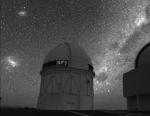 A Cerro Tololo Sky
9.11.2002
High atop a Chilean mountain lies one of the premier observatories of the southern sky: the Cerro Tololo Inter-American Observatory (CTIO). Pictured above is the dome surrounding one of the site's best known instruments, the 4-meter Blanco Telescope.
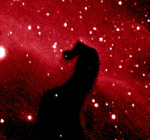 A Close-Up of the Horsehead Nebula
5.10.1996
1500 light years away lies a nebula of quite peculiar shape. How did the dark dust cloud shown above come to be shaped like a horse's head? Nobody knows! Barnard 33, as this...
|
January February March April May June July August September October |
|||||||||||||||||||||||||||||||||||||||||||||||||