
|
You entered: clouds
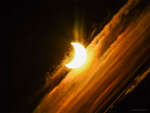 Partial Solar Eclipse over Argentina
2.05.2022
What's happened to the Sun? Two days ago, parts of South America were treated to a partial solar eclipse -- where the Moon blocked out part of the Sun. The featured image shows an image of the partially eclipsed Sun through clouds as it was setting over Patagonia, Argentina.
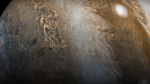 Perijove 11: Passing Jupiter
28.08.2022
Here comes Jupiter! NASA's robotic spacecraft Juno is continuing on its highly-elongated orbits around our Solar System's largest planet. The featured video is from perijove 11 in early 2018, the eleventh time Juno has passed near Jupiter since it arrived in mid-2016.
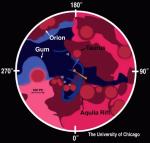 The Solar Neighborhood
25.02.1998
You are here. The orange dot in the above false-color drawing represents the current location of the Sun among local gas clouds in the spiral Milky Way Galaxy. These gas clouds are so thin that we usually see right through them. Nearly spherical bubbles surround regions of recent star formation.
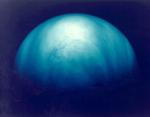 Venus: Just Passing By
25.06.2005
Venus, the second closest planet to the Sun, is by far the brightest of the three planets gathered in this weekend's western sky at sunset. It has also proven to be a popular way-point for spacecraft headed for the gas giant planets in the outer reaches of the solar system. Why visit Venus first?
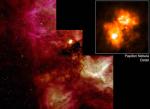 N159 and the Papillon Nebula
14.06.1999
In a search for massive stars, the Hubble Space Telescope has peered into yet another spectacular region of star formation. This nebula, known as N159, spans over 150 light-years and is located in the neighboring Large Magellanic Cloud galaxy, about 170,000 light years distant.
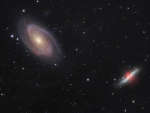 Galaxy Wars: M81 versus M82
25.03.2008
On the left, surrounded by blue spiral arms, is spiral galaxy M81. On the right marked by red gas and dust clouds, is irregular galaxy M82. This stunning vista shows these two mammoth galaxies locked in gravitational combat, as they have been for the past billion years.
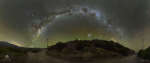 Puzzling a Sky over Argentina
26.07.2016
Can you find the comet? True, a careful eye can find thousands of stars, tens of constellations, four planets, three galaxies, and the central band of our Milky Way Galaxy -- all visible in the sky of this spectacular 180-degree panorama.
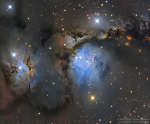 M78 and Orion Dust Reflections
24.01.2017
In the vast Orion Molecular Cloud complex, several bright blue nebulas are particularly apparent. Pictured here are two of the most prominent reflection nebulas - dust clouds lit by the reflecting light of bright embedded stars. The more famous nebula is M78, in the image center, cataloged over 200 years ago.
 Anticrepuscular Rays over Florida
18.03.2020
What's happening behind those clouds? Although the scene may appear somehow supernatural, nothing more unusual is occurring than a Sun setting on the other side of the sky. Pictured here are anticrepuscular rays. To understand them, start by picturing common crepuscular rays that are seen any time that sunlight pours though scattered clouds.
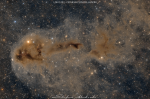 Lynds Dark Nebula 1251
24.11.2022
Stars are forming in Lynds Dark Nebula (LDN) 1251. About 1,000 light-years away and drifting above the plane of our Milky Way galaxy, the dusty molecular cloud is part of a complex of dark nebulae mapped toward the Cepheus flare region.
|
January February March April May June July August September October |
|||||||||||||||||||||||||||||||||||||||||||||||||