
|
You entered: clouds
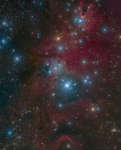 Fox Fur, a Unicorn, and a Christmas Tree
24.12.2016
Clouds of glowing hydrogen gas fill this colorful skyscape in the faint but fanciful constellation Monoceros, the Unicorn. A star forming region cataloged as NGC 2264, the complex jumble of cosmic gas and dust...
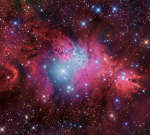 Fox Fur, Unicorn, and Christmas Tree
7.02.2019
Clouds of glowing hydrogen gas fill this colorful skyscape in the faint but fanciful constellation Monoceros, the Unicorn. A star forming region cataloged as NGC 2264, the complex jumble of cosmic gas and dust...
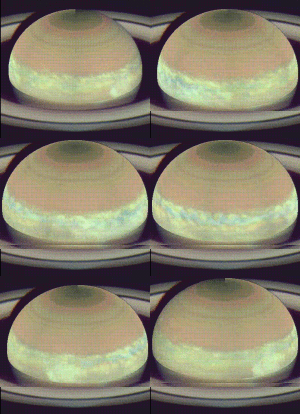 Saturn Rotates
3.10.2000
The dramatic rotation of the cloud-tops of Saturn every ten-hours is particularly evident from orbit around the gas giant planet. With a good enough telescope, however, such rotation is visible even from Earth, as shown by this time-lapse image sequence from the Hubble Space Telescope taken in November 1990.
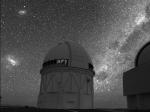 A Cerro Tololo Sky
6.08.2006
High atop a Chilean mountain lies one of the premier observatories of the southern sky: the Cerro Tololo Inter-American Observatory (CTIO). Pictured above is the dome surrounding one of the site's best known instruments, the 4-meter Blanco Telescope.
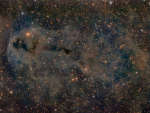 Lynds Dark Nebula 1251
30.09.2016
Stars are forming in Lynds Dark Nebula (LDN) 1251. About 1,000 light-years away, the dusty molecular cloud is part of a complex of dark nebulae mapped toward the Cepheus flare region, drifting above the plane of our Milky Way galaxy.
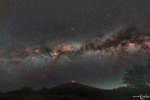 Mount Etna Milky Way
5.07.2024
A glow from the summit of Mount Etna, famous active stratovolcano of planet Earth, stands out along the horizon in this mountain and night skyscape. Bands of diffuse light from congeries of innumerable stars along the Milky Way galaxy stretch across the sky above.
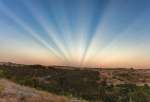 Anticrepuscular Rays over Sicily
25.06.2026
The Sun has just set... in the opposite side of the sky. Pictured here are anticrepuscular rays apparently converging in the east in this image of the limestone plateau in the heart of the Hyblaean Mountains of southeastern Sicily, in Italy. How were these anticrepuscular rays formed, if the Sun wasn't there?
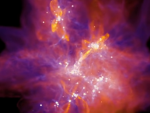 STARFORGE: A Star Formation Simulation
23.06.2021
How do stars form? Most form in giant molecular clouds located in the central disk of a galaxy. The process is started, influenced, and limited by the stellar winds, jets, high energy starlight, and supernova explosions of previously existing stars.
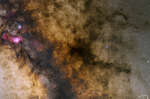 The Central Milky Way from Lagoon to Pipe
1.10.2021
Dark markings and colorful clouds inhabit this stellar landscape. The deep and expansive view spans more than 30 full moons across crowded star fields toward the center of our Milky Way Galaxy. Cataloged in the early 20th century by astronomer E. E.
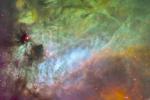 Elements of the Swan Nebula
11.08.2003
In the depths of the dark clouds of dust and molecular gas known as M17, stars continue to form. Also known as the Omega Nebula and Horseshoe Nebula, the darkness of M17's molecular clouds results from background starlight being absorbed by thick filaments of carbon-based smoke-sized dust.
|
January February March April May June July August September October |
|||||||||||||||||||||||||||||||||||||||||||||||||