
|
You entered: clouds
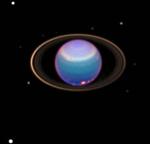 Infrared Uranus
20.10.1998
The Sun's third largest planet usually looks quite dull. Uranus typically appears as a featureless small spot in a small telescope or a featureless large orb in a large telescope. Last August, however...
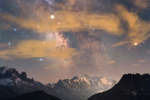 Mont Blanc, Meteor, and Milky Way
15.09.2018
Snowy Mont Blanc is near the center of this atmospheric night skyscape. But high, thin clouds fogged the skies at the photographer's location, looking south toward Europe's highest peak from the southern Swiss Alps.
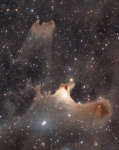 Reflections of the Ghost Nebula
26.10.2020
Do any shapes seem to jump out at you from this interstellar field of stars and dust? The jeweled expanse, filled with faint, starlight-reflecting clouds, drifts through the night in the royal constellation of Cepheus.
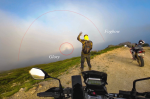 Glory and Fog Bow
3.08.2024
On a road trip up Mount Uludaд in Bursa province, Turkey these motorcyclists found themselves above low clouds and fog in late June. With the bright Sun directly behind them, the view down the side of the great mountain revealed a beautiful, atmospheric glory and fog bow.
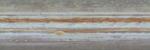 Jupiter Unpeeled
6.09.2003
Slice Jupiter from pole to pole, peel back its outer layers of clouds, stretch them onto a flat surface ... and for all your trouble you'd end up with something that looks a lot like this. Scrolling right will reveal the full picture, a color mosaic of Jupiter from the Cassini spacecraft.
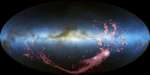 The Magellanic Stream
15.08.2013
In an astronomical version of the search for the source of the Nile, astronomers now have strong evidence for the origin of the Magellanic Stream. This composite image shows the long ribbon...
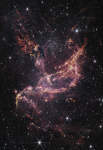 Young Star Cluster NGC 346
13.01.2023
The most massive young star cluster in the Small Magellanic Cloud is NGC 346, embedded in our small satellite galaxy's largest star forming region some 210,000 light-years distant. Of course the massive stars of NGC 346 are short lived, but very energetic.
 Haunting the Cepheus Flare
28.10.2016
Spooky shapes seem to haunt this jeweled expanse, drifting through the night in the royal constellation Cepheus. Of course, the shapes are cosmic dust clouds faintly visible in dimly reflected starlight. Far from your...
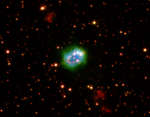 The Necklace Nebula
3.11.2010
The small constellation Sagitta sports this large piece of cosmic jewelry, dubbed the Necklace Nebula. The newly discovered example of a ring-shaped planetary nebula is about 15,000 light-years distant. Its bright ring with pearls of glowing gas is half a light-year across.
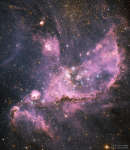 NGC 346: Star Forming Cluster in the SMC
1.12.2020
Are stars still forming in the Milky Way's satellite galaxies? Found among the Small Magellanic Cloud's (SMC's) clusters and nebulas, NGC 346 is a star forming region about 200 light-years across, pictured here in the center of a Hubble Space Telescope image.
|
January February March April May June July August September October |
|||||||||||||||||||||||||||||||||||||||||||||||||