
|
You entered: light
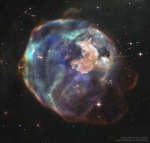 N63A: Supernova Remnant in Visible and X-ray
11.12.2019
What has this supernova left behind? As little as 2,000 years ago, light from a massive stellar explosion in the Large Magellanic Cloud (LMC) first reached planet Earth. The LMC is a close...
 APOD: 2023 August 2 Б M82: Galaxy with a Supergalactic Wind
2.08.2023
Why is the Cigar Galaxy billowing red smoke? M82, as this starburst galaxy is also known, was stirred up by a recent pass near large spiral galaxy M81. This doesn't fully explain the source of the red-glowing outwardly expanding gas and dust, however.
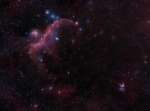 The Seagull and The Duck
19.03.2010
Seen as a seagull and a duck, these nebulae are not the only cosmic clouds to evoke images of flight. But both are winging their way across this broad celestial landscape, spanning almost 7 degrees across planet Earth's night sky toward the constellation Canis Major.
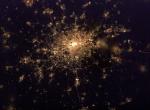 London at Night
11.04.2003
Do you recognize this intriguing globular cluster of stars? It's actually the constellation of city lights surrounding London, England, planet Earth, as recorded with a digital camera from the International Space Station. Taken in February 2003, north is toward the top and slightly left in this nighttime view.
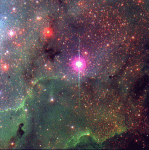 Starbirth in the Lagoon Nebula
24.10.1996
Stars are forming even today in the Lagoon Nebula. This bright nebula is visible in the constellation of Sagittarius with binoculars. The above photo is the result of a new sensitive camera being attached to one of the world's largest telescopes.
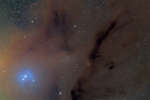 Streaming Dark Nebulas near B44
15.06.2009
Dark dust lit by the bright yellow star Antares highlight this photogenic starscape of the southern sky. A wider angle image shows the central band of our Milky Way Galaxy connected to Antares by streams of dust knows as the Dark River. At the head of the Dark River the dust appears in dense knots.
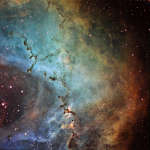 Dust Sculptures in the Rosette Nebula
2.12.2009
What creates the cosmic dust sculptures in the Rosette Nebula? Noted for the common beauty of its overall shape, parts of the Rosette Nebula, also known as NGC 2237, show beauty even when viewed up close.
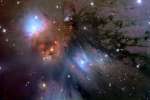 Still Life with NGC 2170
30.12.2010
In this beautiful celestial still life composed with a cosmic brush, dusty nebula NGC 2170 shines at the upper left. Reflecting the light of nearby hot stars, NGC 2170 is joined by other bluish reflection nebulae, a compact red emission region, and streamers of obscuring dust against a backdrop of stars.
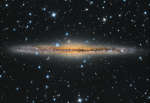 Edge On NGC 891
12.01.2017
Large spiral galaxy NGC 891 spans about 100 thousand light-years and is seen almost exactly edge-on from our perspective. In fact, about 30 million light-years distant in the constellation Andromeda, NGC 891 looks a lot like our Milky Way.
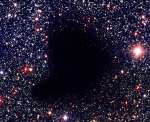 Molecular Cloud Barnard 68
29.01.2012
Where did all the stars go? What used to be considered a hole in the sky is now known to astronomers as a dark molecular cloud. Here, a high concentration of dust and molecular gas absorb practically all the visible light emitted from background stars.
|
January February March April May June July August September October |
|||||||||||||||||||||||||||||||||||||||||||||||||