
|
You entered: light
 Stars, Gas, and Dust Battle in the Carina Nebula
15.08.2017
Chaos reigns in the Carina Nebula where massive stars form and die. Striking and detailed, this close-up of a portion of the famous nebula is a combination of light emitted by hydrogen (shown in red) and oxygen (shown in blue).
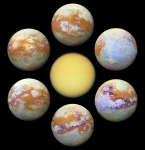 Seeing Titan
18.08.2018
Shrouded in a thick atmosphere, Saturn's largest moon Titan really is hard to see. Small particles suspended in the upper atmosphere cause an almost impenetrable haze, strongly scattering light at visible wavelengths and hiding Titan's surface features from prying eyes.
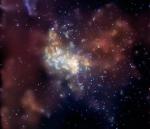 X Rays from the Galactic Core
8.01.2003
Using the orbiting Chandra X-ray Observatory, astronomers have taken this long look at the core of our Milky Way galaxy, some 26,000 light-years away. The spectacular false-color view spans about 130 light-years.
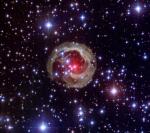 Startling Star V838 Mon
5.12.2003
Variable star V838 Monocerotis startled astronomers in January of 2002, undergoing a dramatic outburst like no other variable star known. Followed closely by ground-based instruments and the Hubble Space Telescope over the following months...
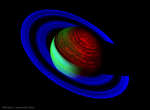 Neon Saturn
13.03.2016
If seen in the right light, Saturn glows like a neon sign. Although Saturn has comparatively little of the element neon, a composite image false-colored in three bands of infrared light highlights features of the giant ringed planet like a glowing sign.
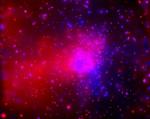 X Rays from M17
21.08.2003
About 5,000 light-years away, toward the constellation Sagittarius and the center of our galaxy, lies the bright star forming region cataloged as M17. In visible light, M17's bowed and hollowed-out appearance has resulted in many popular names like the Horseshoe, Swan, Omega, and Lobster nebula. But what has sculpted this glowing gas cloud?
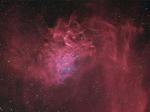 AE Aurigae: The Flaming Star
18.10.2005
Is star AE Aurigae on fire? No. Even though AE Aurigae is named the flaming star, the surrounding nebula IC 405 is named the Flaming Star Nebula, and the region appears to harbor red smoke, there is no fire.
 Elliptical M60, Spiral NGC 4647
14.09.2012
Giant elliptical galaxy M60 and spiral galaxy NGC 4647 do look like an odd couple in this sharp cosmic portrait from the Hubble Space Telescope. But they are found in a region of space where galaxies tend to gather, on the eastern side of the nearby Virgo Galaxy Cluster.
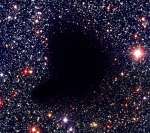 Molecular Cloud Barnard 68
13.12.2014
Where did all the stars go? What used to be considered a hole in the sky is now known to astronomers as a dark molecular cloud. Here, a high concentration of dust and molecular gas absorb practically all the visible light emitted from background stars.
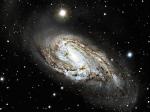 Unusual Spiral Galaxy M66
7.04.2004
Why isn't spiral galaxy M66 symmetric? Usually density waves of gas, dust, and newly formed stars circle a spiral galaxy's center and create a nearly symmetric galaxy. The differences between...
|
January February March April May June July August September October |
|||||||||||||||||||||||||||||||||||||||||||||||||