
|
You entered: light
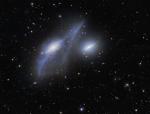 Markarian s Eyes
8.06.2007
Across the heart of the Virgo Galaxy Cluster lies a string of galaxies known as Markarian's Chain. Prominent in Markarian's Chain are these two interacting galaxies, NGC 4438 (left) and NGC 4435 - also known as The Eyes.
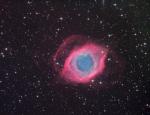 NGC 7293: The Helix Nebula
3.08.2007
A mere seven hundred light years from Earth, in the constellation Aquarius, a sun-like star is dying. Its last few thousand years have produced the Helix Nebula (NGC 7293), a well studied and nearby example of a Planetary Nebula, typical of this final phase of stellar evolution.
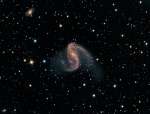 NGC 2442: Galaxy in Volans
28.02.2009
Distorted galaxy NGC 2442 can be found in the southern constellation of the flying fish, (Piscis) Volans. Located about 50 million light-years away, the galaxy's two spiral arms extending from a pronounced central bar give it a hook-shaped appearance.
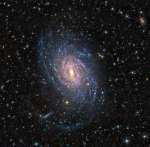 Spiral Galaxy NGC 6744
8.08.2014
Big, beautiful spiral galaxy NGC 6744 is nearly 175,000 light-years across, larger than our own Milky Way. It lies some 30 million light-years distant in the southern constellation Pavo. We see the disk of the nearby island universe tilted towards our line of sight.
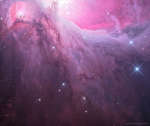 M43: Orion Falls
12.12.2018
Is there a waterfall in Orion? No, but some of the dust in M43 appears similar to a waterfall on Earth. M43, part of the Orion Molecular Cloud Complex, is the often imaged but rarely mentioned neighbor of the more famous M42.
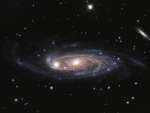 Rubin s Galaxy
25.01.2020
In this Hubble Space Telescope image the bright, spiky stars lie in the foreground toward the heroic northern constellation Perseus and well within our own Milky Way galaxy. In sharp focus beyond is UGC 2885, a giant spiral galaxy about 232 million light-years distant.
 Arp 93: A Cosmic Embrace
16.08.2023
Locked in a cosmic embrace, two large galaxies are merging at the center of this sharp telescopic field of view. The interacting system cataloged as Arp 93 is some 200 million light-years distant toward the constellation Aquarius in planet Earth's sky. Individually the galaxies are identified as NGC 7285 (right) and NGC 7284.
 APOD: 2024 March 20 Б The Eyes in Markarians Galaxy Chain
20.03.2024
Across the heart of the Virgo Galaxy Cluster lies a string of galaxies known as Markarian's Chain. Prominent in Markarian's Chain are these two interacting galaxies, NGC 4438 (left) and NGC 4435 - also known as The Eyes.
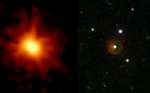 Across the Universe
28.03.2008
How far can you see? Even the faintest stars visible to the eye are merely hundreds or thousands of light-years distant, all well within our own Milky Way Galaxy. Of course, if you know where to look you can also spot the Andromeda Galaxy as a pale, fuzzy cloud, around 2.5 million light-years away.
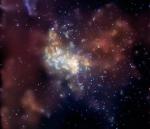 X-Rays from the Galactic Core
6.11.2004
Using the orbiting Chandra X-ray Observatory, astronomers have taken this long look at the core of our Milky Way galaxy, some 26,000 light-years away. The spectacular false-color view spans about 130 light-years.
|
January February March April May June July August September October |
|||||||||||||||||||||||||||||||||||||||||||||||||