
|
You entered: space
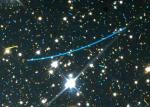 Asteroids in the Distance
23.06.2002
Rocks from space hit Earth every day. The larger the rock, though, the less often Earth is struck. Many kilograms of space dust pitter to Earth daily. Larger bits appear initially as a bright meteor. Baseball-sized rocks and ice-balls streak through our atmosphere daily, most evaporating quickly to nothing.
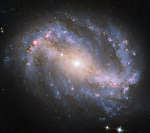 Barred Spiral Galaxy NGC 6217
28.12.2009
Many spiral galaxies have bars across their centers. Even our own Milky Way Galaxy is thought to have a modest central bar. Prominently barred spiral galaxy NGC 6217, pictured above, was captured in spectacular detail in this recently released image taken by the newly repaired Advanced Camera for Surveys on the orbiting Hubble Space Telescope.
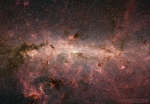 The Galactic Center in Infrared
19.04.2021
What does the center of our galaxy look like? In visible light, the Milky Way's center is hidden by clouds of obscuring dust and gas. But in this stunning vista, the Spitzer Space Telescope's infrared cameras, penetrate much of the dust revealing the stars of the crowded galactic center region.
 M1: The Incredible Expanding Crab
15.11.2023
Cataloged as M1, the Crab Nebula is the first on Charles Messier's famous list of things which are not comets. In fact, the Crab Nebula is now known to be a supernova remnant, an expanding cloud of debris from the death explosion of a massive star.
 M1: The Incredible Expanding Crab
8.05.2025
Cataloged as M1, the Crab Nebula is the first on Charles Messier's famous list of things which are not comets. In fact, the Crab Nebula is now known to be a supernova remnant, an expanding cloud of debris from the death explosion of a massive star.
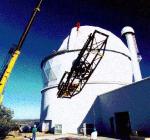 HET: The New Largest Optical Telescope
27.12.1996
Most of our universe is too dim to see. To peer into our cosmos' unknown depths, astronomers must deploy new tools - and the classic new tool is a larger telescope. Pictured above is the new Hobby-Eberly Telescope (HET) which recently declared "first light" in western Texas.
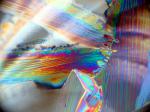 Frizion Illume
26.02.2005
Scientific images of cosmic dust clouds or even frozen water can be esthetic too. In fact, this picture of thin layers of forming ice crystals uses a scientific understanding of light's wave properties solely for artistic purposes. Titled "Illume", the picture was created by astrophysicist Peter Wasilewski.
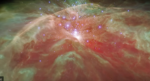 Flight Through the Orion Nebula in Infrared Light
7.07.2021
What would it look like to fly into the Orion Nebula? The exciting dynamic visualization of the Orion Nebula is based on real astronomical data and adept movie rendering techniques. Up close and personal...
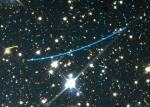 Asteroids in the Distance
17.04.2005
Rocks from space hit Earth every day. The larger the rock, though, the less often Earth is struck. Many kilograms of space dust pitter to Earth daily. Larger bits appear initially as a bright meteor. Baseball-sized rocks and ice-balls streak through our atmosphere daily, most evaporating quickly to nothing.
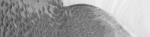 A Martian Metamorphosis
4.06.2002
Is it an Escher, or Mars? Three different types of surfaces visible in the North Polar Cap of Mars morph into each other in a way perhaps reminiscent of the works of M. C. Escher. On the far left dark sand covers the ground, while the center shows a transition to a dune field.
|
January February March April May June July August September October |
|||||||||||||||||||||||||||||||||||||||||||||||||