
|
You entered: space
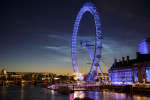 Noctilucent Clouds over London
10.07.2014
This scene from the early morning hours of July 3 looks out across the River Thames from the Westminster Bridge. Part of a luminous timelapse video (vimeo), the frame captures a sight familiar in London, the nighttime glow of the London Eye.
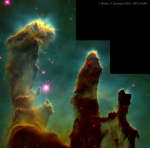 M16: Pillars of Star Creation
24.04.2016
Newborn stars are forming in the Eagle Nebula. This image, taken with the Hubble Space Telescope in 1995, shows evaporating gaseous globules (EGGs) emerging from pillars of molecular hydrogen gas and dust. The giant pillars are light years in length and are so dense that interior gas contracts gravitationally to form stars.
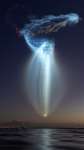 APOD: 2026 March 19 Б Launch Plume: SpaceX Jellyfish
19.03.2026
Even if you live with your head in the clouds, you wonБt find a jellyfish like this one very often. The featured image shows a SpaceX Falcon 9 rocket launch from Cape Canaveral in Florida on March 4.
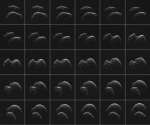 Asteroid 2014 JO25
20.04.2017
A day before its closest approach, asteroid 2014 JO25 was imaged by radar with the 70-meter antenna of NASA's Goldstone Deep Space Communications Complex in California. This grid of 30 radar images, top left to lower right, reveals the two-lobed shape of the asteroid that rotates about once every five hours.
 Newton Crater: Evidence for Recent Water on Mars
26.06.2000
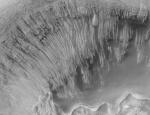
What could have formed these unusual channels? Inside a small crater that lies inside large Newton Crater on Mars, numerous narrow channels run from the top down to the crater floor. The above picture covers a region spanning about 3000 meters across.
 Planet Near a Galaxy Core
5.05.1996
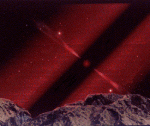
What would the night sky look like if you lived on a planet near the center of a galaxy? Now imagine that this galaxy houses a black hole billions of times more massive than a star. From this spectacular vantage point, the sky might look like the above illustration.
 The Satellites that Surround Earth
14.07.2003
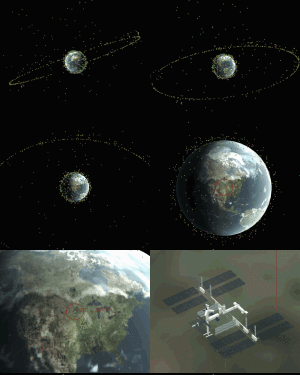
Thousands of satellites orbit the Earth. Costing billions of dollars, this swarm of high altitude robots is now vital to communication, orientation, and imaging both Earth and space. One common type of orbit is geostationary where a satellite will appear to hover above one point on Earth's equator.
 The Smooth Spheres of Gravity Probe B
28.04.2004
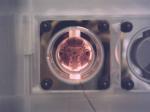
Does gravity have a magnetic counterpart? Spin any electric charge and you get a magnetic field. Spin any mass and, according to Einstein, you should get a very slight effect that acts something like magnetism. This effect is expected to be so small that it is beyond practical experience and even beyond laboratory measurement.
 Night Shining Clouds
5.07.2007
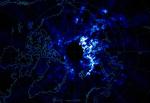
Alluring noctilucent or night-shining clouds lie near the edge of space, some 80 kilometers above Earth's surface. Of course, when viewed from space the clouds are more properly called polar mesospheric clouds (PMCs) -- seen here for the first time in image data from the Aeronomy of Ice in the Mesosphere (AIM) satellite.
 Stardust and Betelgeuse
28.06.2011
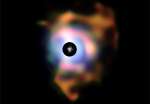
An expansive nebula of dust is seen to surround red supergiant star Betegeuse in this remarkable high resolution composite, an infrared VLT image from the European Southern Observatory. Betelgeuse itself is outlined by the small, central red circle. If found in our own solar system its diameter would almost encompass the orbit of Jupiter.
|
January February March April May June July August September October |
|||||||||||||||||||||||||||||||||||||||||||||||||