
|
You entered: space
 APOD: 2025 April 20 Б The Orion Nebula in Visible and Infrared
20.04.2025
The Great Nebula in Orion is a colorful place. Visible to the unaided eye, it appears as a small fuzzy patch in the constellation of Orion. Long exposure, multi-wavelength images like this, however, show the Orion Nebula to be a busy neighborhood of young stars, hot gas, and dark dust.
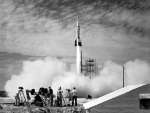 The First Rocket Launch from Cape Canaveral
1.10.2008
A new chapter in space flight began on 1950 July with the launch of the first rocket from Cape Canaveral, Florida: the Bumper 2. Shown above, the Bumper 2 was an ambitious two-stage rocket program that topped a V-2 missile base with a WAC Corporal rocket.
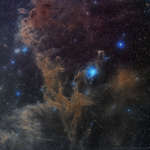 Chamaeleon Dark Nebulas
17.01.2022
Sometimes the dark dust of interstellar space has an angular elegance. Such is the case toward the far-south constellation of Chamaeleon. Normally too faint to see, dark dust is best known for blocking visible light from stars and galaxies behind it.
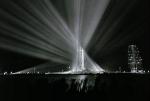 Happy Birthday Jules Verne
6.02.1998
Sunday marks the 170th anniversary of the birth of Jules Verne (born in Nantes, France on the 8th of February, 1828). Inspired by a lifelong fascination with machines, Verne wrote visionary works about "Extraordinary...
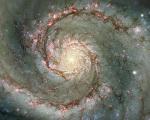 M51: The Whirlpool Galaxy in Dust and Stars
19.02.2006
The Whirlpool Galaxy is a classic spiral galaxy. At only 30 million light years distant and fully 60 thousand light years across, M51, also known as NGC 5194, is one of the brightest and most picturesque galaxies on the sky.
 Dark Sun Sizzling
10.07.2006
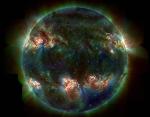
Is this our Sun? Yes. Even on a normal day, our Sun is sizzling ball of seething hot gas. Unpredictably, regions of strong and tangled magnetic fields arise, causing sunspots and bright active regions. The Sun's surface bubbles as hot hydrogen gas streams along looping magnetic fields.
 APOD: 2009 April 7 The Colliding Spiral Galaxies of Arp 274
7.04.2009
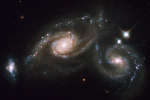
Two galaxies are squaring off in Virgo and here are the latest pictures. When two galaxies collide, the stars that compose them usually do not. This is because galaxies are mostly empty space and, however bright, stars only take up only a small fraction of that space.
 NGC 1499: The California Nebula
10.03.2021
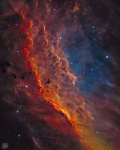
Could Queen Calafia's mythical island exist in space? Perhaps not, but by chance the outline of this molecular space cloud echoes the outline of the state of California, USA. Our Sun has its home within the Milky Way's Orion Arm, only about 1,000 light-years from the California Nebula.
 Barred Spiral Galaxy NGC 1073
20.02.2012
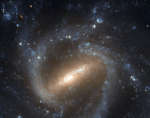
Many spiral galaxies have bars across their centers. Even our own Milky Way Galaxy is thought to have a modest central bar. Prominently barred spiral galaxy NGC 1073, pictured above, was captured in spectacular detail in this recently released image taken by the orbiting Hubble Space Telescope.
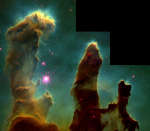 M16: Pillars of Creation
22.07.2012
It was one of the most famous images of the 1990s. This image, taken with the Hubble Space Telescope in 1995, shows evaporating gaseous globules (EGGs) emerging from pillars of molecular hydrogen gas and dust. The giant pillars are light years in length and are so dense that interior gas contracts gravitationally to form stars.
|
January February March April May June July August September October |
|||||||||||||||||||||||||||||||||||||||||||||||||