
|
You entered: water
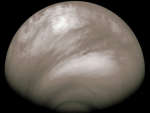 Mysterious Acid Haze on Venus
26.02.2008
Why did an acidic haze spread across Venus? The unusual clouds were discovered last July by ESA's robotic Venus Express spacecraft currently orbiting Venus. The bright and smooth haze was found by Venus...
 Rainbow at Sunset
7.08.2010
Where is the Sun when you see a rainbow? Behind you, of course. But you can see both a rainbow and the Sun (far right) side by side in this graceful panorama recorded on July 28.
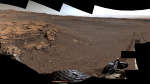 Curiosity at Teal Ridge
8.08.2019
Part of a 360 degree panorama, this view looks out from the Mars rover Curiosity's current location on the Red Planet dubbed Teal Ridge. The mosaicked scene was captured by the rover's Mastcam on Earth calendar date June 18, 2019.
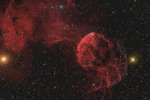 Elusive Jellyfish Nebula
14.05.2009
Normally faint and elusive, the Jellyfish Nebula is caught in this alluring wide-field telescopic view. Flanked by two yellow-tinted stars, Mu and Eta Geminorum, at the foot of a celestial twin, the Jellyfish Nebula is the brighter arcing ridge of emission with dangling tentacles right of center.
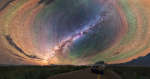 Colorful Airglow Bands Surround Milky Way
6.03.2018
Why would the sky glow like a giant repeating rainbow? Airglow. Now air glows all of the time, but it is usually hard to see. A disturbance however -- like an approaching storm -- may cause noticeable rippling in the Earth's atmosphere.
 Orion and the Ocean of Storms
7.12.2023
On December 5, 2022, a camera on board the uncrewed Orion spacecraft captured this view as Orion approached its return powered flyby of the Moon. Beyond one of Orion's extended solar arrays lies dark, smooth, terrain along the western edge of the Oceanus Procellarum.
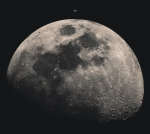 APOD: 2026 April 15 Б The ISS Transits the Moon
15.04.2026
Nope, that is not an alien spaceship landing on the Moon! This is an image of the International Space Station (ISS) as it begins to transit in front of the Moon. The ISS is in low-Earth orbit (LEO) where it wizzes around the Earth every 90 minutes.
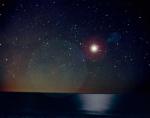 1006 AD: Supernova in the Sky
28.03.2003
A new star, likely the brightest supernova in recorded human history, appeared in planet Earth's sky in the year 1006 AD. The expanding debris cloud from the stellar explosion is still visible to modern astronomers, but what did the supernova look like in 1006?
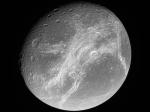 Bright Cliffs Across Saturns Moon Dione
5.09.2006
What causes the bright streaks on Dione? Recent images of this unusual moon by the robot Cassini spacecraft now orbiting Saturn are helping to crack the mystery. Close inspection of Dione's trailing hemisphere, pictured above, indicates that the white wisps are composed of deep ice cliffs dropping hundreds of meters.
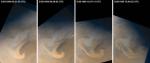 Mars Weather Watch
16.08.1999
Mars may be a cold, dry planet but its weather is dynamic. On June 30, wide angle cameras on board the Mars Global Surveyor (MGS) spacecraft watched the development of this large scale storm system above Mars' north polar area.
|
January February March April May June July August September October |
|||||||||||||||||||||||||||||||||||||||||||||||||