
|
You entered: water
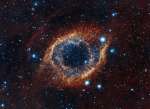 The Helix Nebula from the VISTA Telescope
31.01.2012
Will our Sun look like this one day? The Helix Nebula is one of brightest and closest examples of a planetary nebula, a gas cloud created at the end of the life of a Sun-like star.
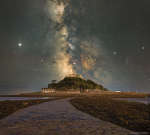 The Milky Way over St Michaels Mount
7.09.2020
Where do land and sky converge? On every horizon -- but in this case the path on the ground leads to St Michael's Mount (Cornish: Karrek Loos yn Koos), a small historic island in Cornwall, England. The Mount is usually surrounded by shallow water, but at low tide is spanned by a human-constructed causeway.
 A December Summer Night
23.12.2023
Colours of a serene evening sky are captured in this 8 minute exposure, made near this December's solstice from New Zealand, southern hemisphere, planet Earth. Looking south, star trails form the short concentric arcs around the rotating planet's south celestial pole positioned just off the top of the frame.
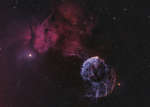 Sharpless 249 and the Jellyfish Nebula
27.02.2026
Normally faint and elusive, the Jellyfish Nebula is caught in this alluring telescopic field of view. Floating in the interstellar sea, the nebula is anchored right and left by two bright stars, Mu and Eta Geminorum, at the foot of the celestial twins.
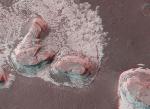 3D Mars: Northern Terra Meridiani
28.08.2002
In this spectacular 3D stereoscopic view from orbit, steep-sided, flat-topped hills stand above the Terra Meridiani region of Mars. Seen best with red/blue glasses (red for the left eye), the structures are reminiscent of buttes and mesas found in southwestern areas of the North American continent on planet Earth.
 Earthset from the Lunar Reconnaissance Orbiter
4.01.2016
On the Moon, the Earth never rises -- or sets. If you were to sit on the surface of the Moon, you would see the Earth just hang in the sky. This is because the Moon always keeps the same side toward the Earth.
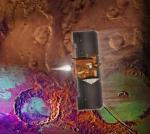 Odyssey at Mars
25.10.2001
After an interplanetary journey lasting 200 days, the Mars Odyssey spacecraft has entered orbit around the Red Planet. This latest success is welcome as in the past, Mars has often seemed a difficult planet to visit.
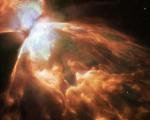 NGC 6302: Big Bright Bug Nebula
5.05.2004
The bright clusters and nebulae of planet Earth's night sky are often named for flowers or insects, and NGC 6302 is no exception. With an estimated surface temperature of about 250,000 degrees...
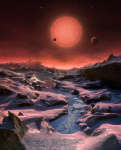 Three Worlds for TRAPPIST 1
7.05.2016
Three new found worlds orbit the ultracool dwarf star TRAPPIST-1, a mere 40 light-years away. Their transits were first detected by the Belgian robotic TRAnsiting Planets and Planetesimals Small Telescope, TRAPPIST, at ESO's La Silla Observatory in Chile. The newly discovered exoplanets are all similar in size to Earth.
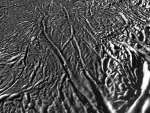 Close Up of Enceladus Tiger Stripes
31.03.2008
Could life exist beneath Enceladus? A recent flyby of Saturn's icy moon has bolstered this fascinating idea. Two years ago, images from the robotic Cassini spacecraft orbiting Saturn led astronomers to the undeniable...
|
January February March April May June July August September October |
|||||||||||||||||||||||||||||||||||||||||||||||||