
|
You entered: unusual
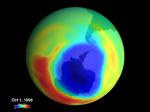 The Worlds Largest Ozone Hole
14.10.1998
It's back, and it's bigger than ever. The ozone hole that has been a cause of concern in recent years has again reformed over Earth's South Pole. The seasonal recurrence of the ozone hole was expected, although the size of the hole has never been so large this early in the season.
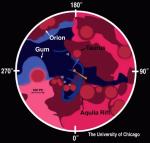 The Solar Neighborhood
24.02.1998
You are here. The orange dot in the above false-color drawing represents the current location of the Sun among local gas clouds in the spiral Milky Way Galaxy. These gas clouds are so thin that we usually see right through them. Nearly spherical bubbles surround regions of recent star formation.
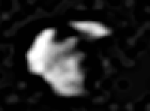 Dione's Lagrange Moon Helene
9.10.1995
Saturn's moon Helene is very unusual in that it circles Saturn near the orbit of a bigger moon: Dione. Helene is situated in what is called a "Lagrange point" of Dione - a place of stability created by Dione's gravity.
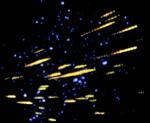 Meteors Now and Again
10.08.1998
The Perseid Meteor Shower, usually the best meteor shower of the year, will peak over the next two nights. Over the course of an hour, a person watching a clear sky from a dark location might see as many as 100 meteors.
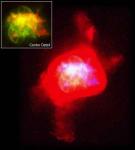 NGC 6210: The Turtle in Space Planetary Nebula
27.10.1998
A Turtle in Space? Planetary nebula NGC 6210 may look like a giant space turtle, but it is actually much more massive and violent. Fortunately, this gas cloud in Hercules lies about 6500 light years away.
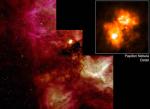 N159 and the Papillon Nebula
14.06.1999
In a search for massive stars, the Hubble Space Telescope has peered into yet another spectacular region of star formation. This nebula, known as N159, spans over 150 light-years and is located in the neighboring Large Magellanic Cloud galaxy, about 170,000 light years distant.
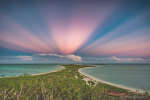 Anticrepuscular Rays over Florida
17.03.2020
What's happening behind those clouds? Although the scene may appear somehow supernatural, nothing more unusual is occurring than a Sun setting on the other side of the sky. Pictured here are anticrepuscular rays. To understand them, start by picturing common crepuscular rays that are seen any time that sunlight pours though scattered clouds.
 APOD: 2023 October 25 Б Gone in 60 Seconds: A Green Flash Sunset
24.10.2023
In 60 seconds, this setting Sun will turn green. Actually, the top of the Sun already appears not only green, but wavey -- along with all of its edges. The Sun itself is unchanged -- both effects are caused by looking along hot and cold layers in Earth's atmosphere.
 APOD: 2024 March 4 Б Light Pillars Over Inner Mongolia
3.03.2024
What's happening across that field? Pictured here are not auroras but nearby light pillars, a phenomenon typically much closer. In most places on Earth, a lucky viewer can see a Sun pillar, a column of light appearing to extend up from the Sun caused by flat fluttering ice-crystals reflecting sunlight from the upper atmosphere.
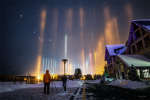 APOD: 2026 March 23 Б Light Pillars and Orion over Mohe
22.03.2026
What's happening at the end of that street? Pictured here are not auroras but light pillars, a phenomenon typically much closer. In most places on Earth, a lucky viewer...
|
January February March April May June July August |
||||||||||||||||||||||||||||||||||||||||||||||||||||||||