
|
You entered: unusual
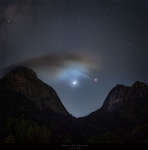 Venus and Mars: Passing in the Night
29.03.2022
When two planets pass on the night sky, they can usually be seen near each other for a week or more. In the case of this planetary conjunction, Venus and Mars passed within 4 degrees of each other earlier this month.
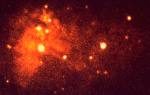 LMC X-1: A Black Hole Candidate
30.12.1995
The strongest source of X-rays in the Large Magellanic Cloud originates from an unusually energetic binary star system. This strong source, dubbed LMC X-1, is thought to be a normal and compact star orbiting each other. Gas stripped of the normal star falls onto the compact star, heats up, and emits X-rays.
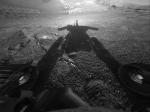 Shadow of a Martian Robot
3.08.2004
What if you saw your shadow on Mars and it wasn't human? Then you might be the Opportunity rover currently exploring Mars. Opportunity and sister robot Spirit have been probing the red planet since January, finding evidence of ancient water, and sending breathtaking images across the inner Solar System.
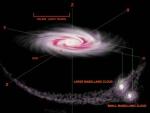 The Magellanic Stream
26.08.1998
Spanning the sky behind the majestic Clouds of Magellan is an unusual stream of gas: the Magellanic Stream. The origin of this gas might hold a clue to origin and fate of our Milky Way's most famous satellite galaxies: the LMC and the SMC.
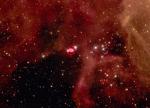 A Supernova Starfield
9.02.1999
Bright stars don't last forever. A bright star similar to others in this field exploded in a spectacular supernova that was witnessed on Earth in 1987. The result is visible even today as unusual rings and glowing gas. The above picture is a composite of recent images taken over several years.
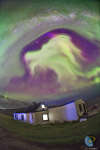 Goat Aurora Over Greenland
3.10.2012
Sometimes it's hard to believe what you see in the sky. During the Shelios Expedition to Greenland in late August, even veteran sky enthusiasts saw auroras so colorful, so fast changing, and so unusual in form that they could remember nothing like it.
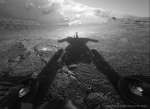 APOD: 2026 February 22 Б Shadow of a Martian Robot
22.02.2026
What if you saw your shadow on Mars and it wasn't human? Then you might be the Opportunity rover exploring Mars. Opportunity explored the Red Planet from 2004 to 2018, finding evidence of ancient water, and sending breathtaking images across the inner Solar System.
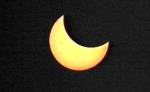 A Partial Eclipse in Southern Skies
3.09.1997
Location is everything, especially if you want to see a Solar Eclipse. These fleeting events are only visible to those in the path of the Moon's shadow as it races across the Earth.
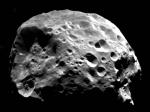 Phoebe: Comet Moon of Saturn
30.06.2004
Was Saturn's moon Phoebe once a comet? Images from the robotic Cassini spacecraft taken two weeks ago when entering the neighborhood of Saturn indicate that Phoebe may have originated in the outer Solar System.
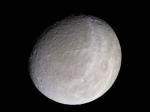 Saturns Moon Rhea from Cassini
15.02.2005
Each moon of Saturn seems to come with its own mystery. Rhea, Saturn's second largest moon behind Titan, shows unusual wisps, visible above as light colored streaks. Higher resolution images of the wisps show them to be made of long braided fractures.
|
January February March April May June July August |
||||||||||||||||||||||||||||||||||||||||||||||||||||||||