
|
You entered: disk
 Blue Ghost s Diamond Ring
19.03.2025
On March 14 the Full Moon slid through Earth's dark umbral shadow and denizens of planet Earth were treated to a total lunar eclipse. Of course, from the Moon's near side that same astronomical syzygy was seen as a solar eclipse.
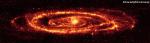 The Andromeda Galaxy in Infrared
20.10.2005
What is the Andromeda galaxy really like? To find out, astronomers looked at our largest galactic neighbor in a different light: infrared. Astronomers trained the orbiting Spitzer Space Telescope at the Messier monster (M31) for over 18 hours, creating a mosaic that incorporated 11,000 separate exposures.
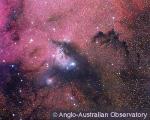 Reflections on NGC 6188
25.08.1999
NGC 6188 is an interstellar carnival of young blue stars, hot red gas, and cool dark dust. Located 4000 light years away in the disk of our Galaxy, NGC 6188 is home to the Ara OB1 association, a group of bright young stars whose nucleus forms the open cluster NGC 6193.
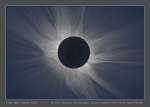 Corona from Svalbard
31.03.2015
During a total solar eclipse, the Sun's extensive outer atmosphere, or corona, is an inspirational sight. Streamers and shimmering features that engage the eye span a brightness range of over 10,000 to 1, making them notoriously difficult to capture in a single photograph.
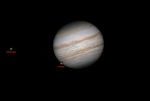 Jupiter Rotates as Moons Orbit
25.10.2022
Jupiter and its moons move like our Sun and its planets. Similarly, Jupiter spins while its moons circle around. JupiterБs rotation can be observed by tracking circulating dark belts and light zones. The Great Red Spot, the largest storm known, rotates to become visible after about 15 seconds in the 48-second time lapse video.
 APOD: 2023 July 17 Б Shells and Arcs around Star CW Leonis
17.07.2023
What's happening around this star? No one is sure. CW Leonis is the closest carbon star, a star that appears orange because of atmospheric carbon dispersed from interior nuclear fusion. But CW Leonis also appears engulfed in a gaseous carbon-rich nebula.
 APOD: 2024 April 2 Б Detailed View of a Solar Eclipse Corona
2.04.2024
Only in the fleeting darkness of a total solar eclipse is the light of the solar corona easily visible. Normally overwhelmed by the bright solar disk, the expansive corona, the sun's outer atmosphere, is an alluring sight.
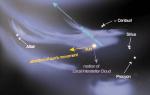 The Local Interstellar Cloud
11.04.2000
The stars are not alone. In the disk of our Milky Way Galaxy about 10 percent of visible matter is in the form of gas, called the interstellar medium (ISM). The ISM is not uniform, and shows patchiness even near our Sun.
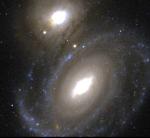 Galaxies Away
21.08.1999
This striking pair of galaxies is far, far away ... about 350 million light-years from Earth. Cataloged as AM0500-620, the pair is located in the southern constellation Dorado. The background elliptical and foreground spiral galaxy are representative of two of the three major classes of galaxies which inhabit our Universe.
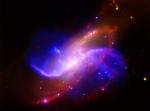 The Arms of NGC 4258
11.04.2007
Better known as M106, bright spiral galaxy NGC 4258 is about 30 thousand light years across and 21 million light years away toward the northern constellation Canes Venatici. The yellow and red hues in this composite image show the galaxy's sweeping spiral arms as seen in visible and infrared light.
|
January February March April |
|||||||||||||||||||||||||||||||||||||||||||||||||