
|
You entered: disk
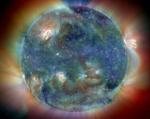 Solstice Celebration
20.06.2004
Season's greetings! Today or tomorrow, depending on your time zone, the Sun reaches its northernmost point in planet Earth's sky marking a season change and the first solstice of the year 2004. In celebration, consider this delightfully detailed, brightly colored image of the active Sun.
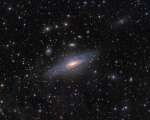 NGC 7331 and Beyond
12.08.2011
Big, beautiful spiral galaxy NGC 7331 is often touted as an analog to our own Milky Way. About 50 million light-years distant in the northern constellation Pegasus, NGC 7331 was recognized early on as a spiral nebula and is actually one of the brighter galaxies not included in Charles Messier's famous 18th century catalog.
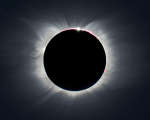 A Total Eclipse of the Sun
9.12.2021
Few were able to stand in the Moon's shadow and watch the December 4 total eclipse of the Sun. Determined by celestial mechanics and not geographical boundaries, the narrow path of totality tracked across planet Earth's relatively inaccessible southernmost continent.
 Dione and Rhea Ring Transit
22.11.2025
Seen to the left of Saturn's banded planetary disk, small icy moons Dione and Rhea are caught passing in front of the gas giant's extensive ring system in this sharp telescopic snapshot. The remarkable image was recorded on November 20, when Saturn's rings were nearly edge-on when viewed from planet Earth.
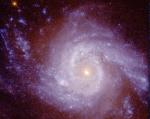 Spiral Galaxy NGC 3310 in Ultraviolet
17.01.2001
Why is NGC 3310 bursting with young stars? The brightest of these new stars are so hot that they light up this spiral galaxy not only in blue light, but in light so blue humans can't see it: ultraviolet. The Hubble Space Telescope took the above photograph in different bands of ultraviolet light.
 Gamma Ray Bursts from the Unknown
23.11.1996
Gamma Ray Bursts (GRBs) pose one of the greatest mysteries of modern astronomy. About once a day, the gamma-ray sky lights up with a spectacular explosion. No one knows what causes these explosions or even how far away they are.
 Ring of Fire Revisited
30.05.2003
Early on Saturday, May 31 (UT) the new Moon will once again slide across the Sun's fiery disk, and once again an annular solar eclipse will be the result -- since the Moon's apparent diameter will be a little too small to completely cover the Sun.
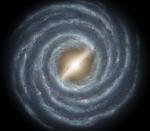 Barred Spiral Milky Way
25.08.2005
A recent survey of stars conducted with the Spitzer Space Telescope is convincing astronomers that our Milky Way Galaxy is not just your ordinary spiral galaxy anymore. Looking out from within the Galaxy's disk, the true structure of the Milky Way is difficult to discern.
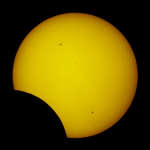 Eclipsing the Sun
5.01.2011
Skywatchers throughout much of Europe, North Africa, and Central Asia, were treated to the first eclipse of the new year on January 4, a partial eclipse of the Sun. But traveling to the area...
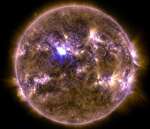 Sun with Solar Flare
13.04.2013
This week the Sun gave up its strongest solar flare so far in 2013, accompanied by a coronal mass ejection (CME) headed toward planet Earth. A false-color composite image in extreme ultraviolet light from the Solar Dynamics Observatory captures the moment, recorded on April 11 at 0711 UTC. The flash, a moderate, M6.
|
January February March April |
|||||||||||||||||||||||||||||||||||||||||||||||||