
|
You entered: disk
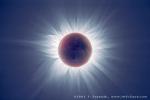 Moon AND Sun
22.11.2003
This composite image was made from 22 separate pictures of the Moon and Sun all taken from Chisamba, Zambia during the total phase of the 2001 June 21 solar eclipse. The multiple exposures were...
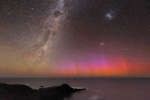 Red Aurora Over Australia
1.02.2012
Why would the sky glow red? Aurora. Last week's solar storms, emanating mostly from active sunspot region 1402, showered particles on the Earth that excited oxygen atoms high in the Earth's atmosphere. As the excited element's electrons fell back to their ground state, they emitted a red glow.
 AR 2192: Giant on the Sun
24.10.2014
As you (safely!) watched the progress of yesterday's partial solar eclipse, you probably also spotted a giant sunspot group. Captured in this sharp telescopic image from October 22nd the complex AR 2192 is beautiful to see, a sprawling solar active region comparable in size to the diameter of Jupiter.
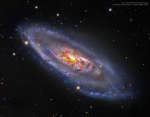 M106: A Spiral Galaxy with a Strange Center
15.02.2015
What's happening at the center of spiral galaxy M106? A swirling disk of stars and gas, M106's appearance is dominated by blue spiral arms and red dust lanes near the nucleus, as shown in the featured image.
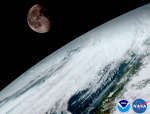 GOES 16: Moon over Planet Earth
26.01.2017
Launched last November 19 from Cape Canaveral Air Force Station, the satellite now known as GOES-16 can now observe planet Earth from a geostationary orbit 22,300 miles above the equator. Its Advanced Baseline Imager captured this contrasting view of Earth and a gibbous Moon on January 15.
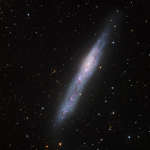 Magellanic Galaxy NGC 55
12.07.2019
Irregular galaxy NGC 55 is thought to be similar to the Large Magellanic Cloud (LMC). But while the LMC is about 180,000 light-years away and a well-known satellite of our own Milky Way Galaxy, NGC 55 is more like 6 million light-years distant, a member of the Sculptor Galaxy Group.
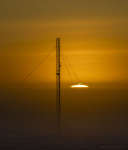 Sunrise at the South Pole
5.10.2021
Sunrise at the South Pole is different. Usually a welcome sight, it follows months of darkness -- and begins months of sunshine. At Earth's poles, it can take weeks for the Sun to rise, in contrast with just minutes at any mid-latitude location.
 APOD: 2026 January 26 Б NGC 55: A Galaxy of Nebulas
26.01.2026
Can you see nebulas in other galaxies? Yes, some nebulas shine brightly enough -- if you know how to look. Clouds of hydrogen and oxygen emit light at very specific colors, and by isolating them, astronomers and astrophotographers can reveal structures that would otherwise be too faint to notice.
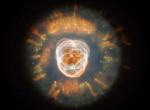 The Eskimo Nebula from the Newly Fixed Hubble
24.01.2000
In 1787, astronomer William Herschel discovered the Eskimo Nebula. From the ground, NGC 2392 resembles a person's head surrounded by a parka hood. In 2000, just after being fixed, the Hubble Space Telescope imaged the Eskimo Nebula. From space, the nebula displays gas clouds so complex they are not fully understood.
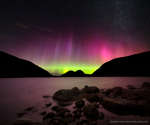 Aurora over Maine
17.09.2014
It has been a good week for auroras. Earlier this month active sunspot region 2158 rotated into view and unleashed a series of flares and plasma ejections into the Solar System during its journey across the Sun's disk.
|
January February March April May |
|||||||||||||||||||||||||||||||||||||||||||||||||