
|
You entered: disk
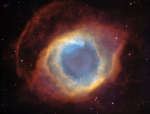 The Helix Nebula from Blanco and Hubble
12.10.2014
How did a star create the Helix nebula? The shapes of planetary nebula like the Helix are important because they likely hold clues to how stars like the Sun end their lives. Observations...
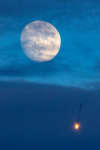 A Falcon 9 Moon
5.09.2020
Illuminating planet Earth's night, full moons can have many names. This year the last full moon of northern hemisphere summer was on September 2, known to some as the Full Corn Moon.
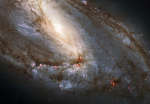 Messier 66 Close Up
13.06.2024
Big, beautiful spiral galaxy Messier 66 lies a mere 35 million light-years away. The gorgeous island universe is about 100 thousand light-years across, similar in size to the Milky Way. This Hubble Space Telescope close-up view spans a region about 30,000 light-years wide around the galactic core.
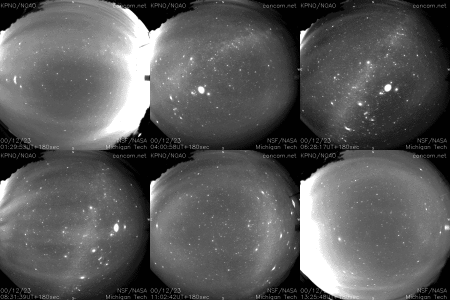 Watch the Sky Rotate
10.01.2001
If you could watch the sky for an entire night, what would you see? The above time-lapse sequence from the CONtinuous CAMera (CONCAM) project shows the answer for the skies above Kitt Peak National Observatory on 2000 December 23.
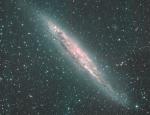 Nearby Spiral Galaxy NGC 4945
21.07.2002
For such a close galaxy, NGC 4945 is easy to miss. NGC 4945 is a spiral galaxy in the Centaurus Group of galaxies, located only six times farther away than the prominent Andromeda Galaxy. The thin disk galaxy is oriented nearly edge-on, however, and shrouded in dark dust.
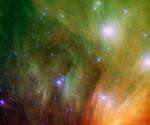 Seven Dusty Sisters
13.04.2007
Hurtling through a cosmic dust cloud a mere 400 light-years away, the lovely Pleiades or Seven Sisters star cluster is well-known in astronomical images for its striking blue reflection nebulae. At visible wavelengths...
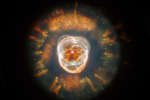 The Eskimo Nebula from Hubble
3.05.2009
In 1787, astronomer William Herschel discovered the Eskimo Nebula. From the ground, NGC 2392 resembles a person's head surrounded by a parka hood. In 2000, the Hubble Space Telescope imaged the Eskimo Nebula. From space, the nebula displays gas clouds so complex they are not fully understood.
 Eclipsed Moon in the Milky Way
17.06.2011
On June 15, the totally eclipsed Moon was very dark, with the Moon itself positioned on the sky toward the center of our Milky Way Galaxy. This simple panorama captures totality from northern Iran in 8 consecutive exposures each 40 seconds long.
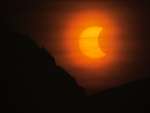 Solar Eclipse over Antarctica
2.12.2011
Last Friday, the fourth and final partial solar eclipse of 2011 was only visible from high latitudes in the southern hemisphere. If you missed it, check out this dramatic picture of the geocentric celestial event from a very high southern latitude on the continent of Antarctica.
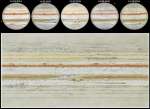 Jupiter Unplugged
2.03.2012
Five hand drawn sketches of Jupiter were used to create this beautifully detailed flat map of the ruling gas giant's turbulent cloud tops. Made with colored pencils at the eyepiece of a 16 inch diameter telescope, the original drawings are about 5 inches (12.5 cm) in diameter.
|
January February March April |
|||||||||||||||||||||||||||||||||||||||||||||||||