
|
You entered: disk
 APOD: 2024 January 8 Б The Phases of Venus
8.01.2024
Venus goes through phases. Just like our Moon, Venus can appear as a full circular disk, a thin crescent, or anything in between. Venus, frequently the brightest object in the post-sunset or pre-sunrise sky, appears so small, however, that it usually requires binoculars or a small telescope to clearly see its current phase.
 Reflections on VdB 31
13.02.2025
Riding high in the constellation of Auriga, beautiful, blue VdB 31 is the 31st object in Sidney van den Bergh's 1966 catalog of reflection nebulae. It shares this well-composed celestial still life with dark, obscuring clouds B26, B27, and B28, recorded in Edward E. Barnard's 1919 catalog of dark markings in the sky.
 Supernova 1994D and the Unexpected Universe
12.03.2000
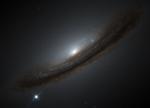
Far away, long ago, a star exploded. Supernova 1994D, visible as the bright spot on the lower left, occurred in the outskirts of disk galaxy NGC 4526. Supernova 1994D was not of interest for how different it was, but rather for how similar it was to other supernovae. In fact, the
 Detailed View of a Solar Eclipse Corona
16.03.2010
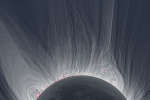
Only in the fleeting darkness of a total solar eclipse is the light of the solar corona easily visible. Normally overwhelmed by the bright solar disk, the expansive corona, the sun's outer atmosphere, is an alluring sight.
 Surprising Comet ISON
30.11.2013
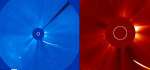
After failing to appear for Sun staring spacecraft at perihelion, its harrowing closest approach to the Sun, sungrazing Comet ISON was presumed lost. But ISON surprised observers yesterday as material still traveling along the comet's trajectory became visible and even developed an extensive fan-shaped dust tail.
 NGC 247 and Friends
30.03.2018
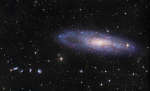
About 70,000 light-years across, NGC 247 is a spiral galaxy smaller than our Milky Way. Measured to be only 11 million light-years distant it is nearby though. Tilted nearly edge-on as seen from our perspective, it dominates this telescopic field of view toward the southern constellation Cetus.
 Quarter Moons
21.10.2023
Half way between New Moon and Full Moon is the Moon's first quarter phase. That's a quarter of the way around its moonthly orbit. At the first quarter phase, half the Moon's visible side is illuminated by sunlight.
 APOD: 2024 May 7 Б Black Hole Accreting with Jet
7.05.2024
What happens when a black hole devours a star? Many details remain unknown, but observations are providing new clues. In 2014, a powerful explosion was recorded by the ground-based robotic telescopes of the All Sky Automated Survey for SuperNovae (Project ASAS-SN), with followed-up observations by instruments including NASA's Earth-orbiting Swift satellite.
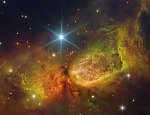 Star Forming Region S106
7.11.2011
Massive star IRS 4 is beginning to spread its wings. Born only about 100,000 years ago, material streaming out from this newborn star has formed the nebula dubbed Sharpless 2-106 Nebula (S106), pictured above.
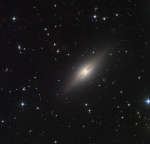 NGC 7814: The Little Sombrero in Pegasus
30.06.2017
Point your telescope toward the high flying constellation Pegasus and you can find this expanse of Milky Way stars and distant galaxies. Dominated by NGC 7814, the pretty field of view would almost be covered by a full moon.
|
January February March April |
|||||||||||||||||||||||||||||||||||||||||||||||||