
|
You entered: disk
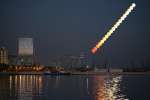 Baku Moonrise
8.12.2012
A Full Moon rises in this waterfront scene. Its colorful, watery reflection is joined by harbor lights and a windowed skyscraper's echo of the western horizon just after sunset. The tantalizing image is a composite of frames recorded at 2 minute intervals on November 28 from the Caspian Sea port city of Baku, Azerbaijan.
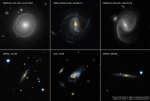 Spiral Galaxies Spinning Super Fast
5.11.2019
Why are these galaxies spinning so fast? If you estimated each spiral's mass by how much light it emits, their fast rotations should break them apart. The leading hypothesis as to why these galaxies don't break apart is dark matter -- mass so dark we can't see it.
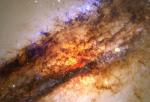 The Center of Centaurus A
22.05.1998
A fantastic jumble of young blue star clusters, gigantic glowing gas clouds, and imposing dark dust lanes surrounds the central region of the active galaxy Centaurus A. This mosaic of Hubble Space Telescope images taken in blue, green, and red light has been processed to present a natural color picture of this cosmic maelstrom.
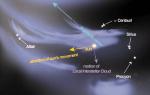 The Local Interstellar Cloud
10.02.2002
The stars are not alone. In the disk of our Milky Way Galaxy about 10 percent of visible matter is in the form of gas, called the interstellar medium (ISM). The ISM is not uniform, and shows patchiness even near our Sun.
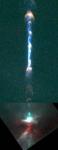 HH111's 12 Light-Year Star Jet
21.03.2000
The complex interactions of three stars in the Orion B molecular cloud complex have resulted in the ejection of particles along a 12 light-year long jet. One of the stars in the HH111 system has apparently also been ejected leaving two stars tightly bound in a binary orbit.
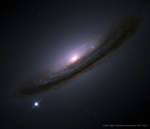 Supernova 1994D and the Unexpected Universe
31.05.2015
Long ago, far away, a star exploded. Supernova 1994D, visible as the bright spot on the lower left, occurred in the outskirts of disk galaxy NGC 4526. Supernova 1994D was not of interest for how different it was, but rather for how similar it was to other supernovae.
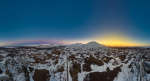 Shadowrise and Sunset
1.06.2017
The road tracking through this stunning 360 degree view crosses a remote mountain area of Jämtland, Sweden, planet Earth. A 3x8 mosaic of still images, the panorama was taken on May 3rd from a small drone 200 meters above the ground.
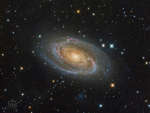 Messier 81
17.04.2019
One of the brightest galaxies in planet Earth's sky is similar in size to our Milky Way Galaxy: big, beautiful Messier 81. Also known as NGC 3031 or Bode's galaxy for its 18th century discoverer, this grand spiral can be found toward the northern constellation of Ursa Major, the Great Bear.
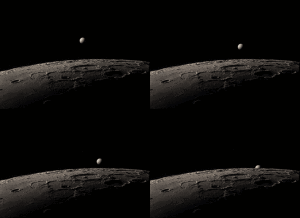 Lunar Occultation of Venus
2.06.2022
On May 27 Venus rose as the morning star, near the waning crescent Moon in a predawn sky already full of planets. It was close on the sky to the Moon's crescent and a conjunction of the second an third brightest celestial beacons were enjoyed by skygazers around the world.
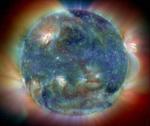 Solstice Celebration
21.06.2000
Season's greetings! At 01:48 Universal Time on June 21 the Sun reaches its northernmost point in planet Earth's sky marking a season change and the first solstice of the year 2000. In celebration, consider this delightfully detailed, brightly colored image of the active Sun.
|
January February March April |
|||||||||||||||||||||||||||||||||||||||||||||||||